Remain Calm and…WTF?

Monster 1

So here we are. No more complacency. Now everyone knows what a black swan is. She’s swimming by as I speak. Interesting thing is, as rare as she is, she’s not the only one. Some are larger, some smaller, some less ‘dark’ perhaps than this one, but we’ve seen them swim by before. They’re those things we don’t see coming…and we’re generally glad when they leave ‘cuz they’re ugly, at least on the surface.

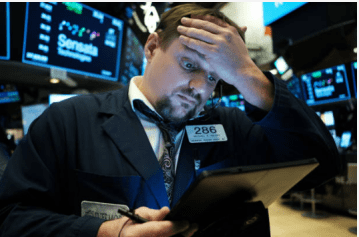
What am I talking about? The current market conditions. I can’t and therefore won’t speak to the health ramifications and related issues. There are people that do that every day and know way more than I do. What I do know about is market events. They do happen. With an interesting degree of regularity. For one would think that some of these events should be remembered longer; should be felt longer. These events create pain. They create financial pain that easily leads to mental pain that, unfortunately, even more easily can lead to physical pain. And yet, we forget them. Probably healthier in many ways. Let’s us move forward. Maybe some sort of reaction to economic PTSD.

Please don’t think I’m using that term lightly or with any degree of sarcasm. When you lose a job, when you lose a house, when you worry about your family’s future as the result of an economic event, I have to argue this counts as PTSD. But one of the positives of the economic kind of shock and lingering syndrome, is that we suffer as a group and recover as a group. And economics, unlike emotions, seem to recover every time. Like the swans themselves, you don’t know how long that recovery will take. But you know it will come. Remember those pendulums we discussed a little while back? If ever there was an extreme, this is it.

In just over 40 years, we’ve seen the Crash of ’87, the Internet Bubble of 2000, the Great Recession of 2008, and now this. Pretty regular. And each time, we think this is the time we won’t recover. Each time, we wonder how we ever let it get that far away from us. How did we not know this was coming? Well, we didn’t want to. Having way too much fun. Bring up things like portfolio insurance and hedges, all of a sudden you’re the ‘Debbie Downer’ of the party. Why would I hedge when I can make so much more this way? It’s all going up. It’s not gonna go down. And when it does, we’ll all know it.

Pick any of the above years. Same words each time. First time, I was one of the crowd. Second time, thought I heard an echo. Third time, knew I’ve seen the movie, just wasn’t in a position to capitalize. This time? I’m keeping my perspective and I’m doing my homework. It’s not going to be easy. But opportunities will present themselves. Many of those will seem obvious when looking back in a few years. Things like lots of “Pandemic Babies” feeding infant supply companies…everyone needs a diaper when they start. Sounds humorous, but we’re all home these days.

I remember 9/11 babies. And every year, and the victorious city, nine months after the super bowl is this crazy increase in births. All within a week. Go figure. Misery, fear and celebrations all leading to the same conclusion; rebirth. And as corny as it sounds, that’s what we’re going to observe on an economic basis. People will act slower, will do more research, will run lots of ‘what if’ scenarios in their heads, but in the end, they’ll still buy houses, cars, trips and all the same things they’ve bought before. And like those consumers, investors also need to add that extra level of analysis. But start with common sense. Start with perspective.

Recessions last an average of 6 – 9 months. And let’s not fool ourselves, with the equity markets down 30% from the peak, interest rates forced to zero and earnings thrown into question for a few months, avoiding a recession would be a much larger surprise than entering one. The job market alone will be frozen for the next 2 – 3 months. Just the act of interviewing is thrown into disarray. Companies can’t hire when they can’t interview. Heck, right now they don’t even know if their network infrastructures can handle the employees they have…when everyone is working from home.

So take some time. You’ve got it now. Rediscover conversation with family and friends. Might as well. Can only binge so many streamed shows before you need some human interaction. And that could lead to investment ideas. One person brings up diapers as an investment, maybe another says people will take vacations again in six months…cruise industry maybe a longer wait. The point is there are and will be opportunities and some people will take advantage of. And it doesn’t need to be the professionals. Sometimes they miss the most obvious winners. Even I’ll admit that not all great investment and trading ideas are borne out of charts (as much as I’d like to think they all are). Much of it is common sense. Much of it is just a bit of thought. And all of it comes back to my favorite word, uttered in this blog of mine many times; Perspective…this time mixed with some Patience.
What Time Is It? What Day Is It?

Melting Clock

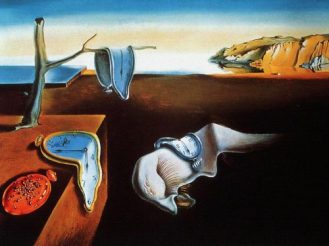
I’ve been using charts for a long time. Bar charts, Point and Figure, Market Profile, and of course Candlestick charts. In fact, I build a platform that provides charts. Well, time series charts, where time is measured in equal increments along the X (Bottom) Axis. And that comprises most of the universe of chart technicians, or technical analysts. It makes sense. Everything we do is time based. Going to school or work in the morning, coming home in the afternoon or evening. We do that, generally, five days each week. I get paid twice every month. And every year I celebrate the same holidays. They mark the passage of another year, most notably acknowledged at the transition from December 31st to January 1st, aka New Year’s.

Traditionally, trading markets easily facilitated the use of time series charts. There was an opening time and a closing time each day. There was a break for the weekend. Many markets have come close to 24/7, but not quite, and therefore the traditional time series charts still work. But I work in crypto now, and something I’ve realized is that this is a pretty random thing to do now, create a time series chart. Why do I say that? Well, the crypto markets truly never sleep.

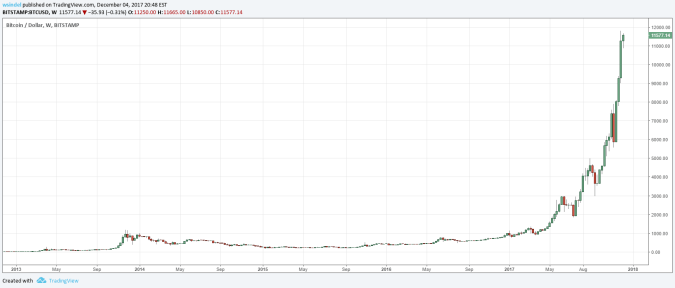
Earlier in my crypto involvement, prior to landing my current role, I interviewed with a company trying to create their own crypto exchange. They let me know that their plan was to close for up to 15 minutes a day, with up to a one hour break each weekend to reset, reboot, or re-something that seemed to me to be not very well thought out. If you are the only exchange, or the largest exchange it’s relatively routine to impose your own rules on a trading community. This company was a startup. This was in 2017 when crypto was at the early stage of going ballistic, both with a parabolic price move and previously unexperienced volume.

And they were going to close regularly. I explained that as someone being brought in to build a product and know the audience, one thing I was sure about with the trading community was that if you were the only exchange closed at the busiest moment of a busy day, you were closed at the wrong time. No matter the time, based on the situation, it would be the wrong time. And customers would go elsewhere. And once gone to another exchange, they would need an excuse to leave and come back. It was a bad plan. They didn’t understand the business they wanted to get into. I didn’t go work there.

Back to the charts themselves. If we decide that we really can’t close, then how do I build a bar or a candle? So we use midnight UTC time for open and close. But it really isn’t. It’s just 12:00 a.m. in a small segment of the earth. And weekly charts? When I got where I am now, our weeks started on Thursday at 12:00 a.m. because that was the time that computer clocks rolled their weeks according to Unix time. Why? Because someone decided that the beginning of time should be January 1, 1970.

And how was this decision reached? I’ve read it was the birth of Unix; I’ve also read it was convenient since Unix had been around for a while already. Kind of arbitrary, huh? Crazy to imagine there was no reason to ‘count time’ (that’s what Unix time does) prior to 1970. A lot of cool and important stuff happened prior to 1970. Someone put in an arbitrary cut-off.

We still do that with our charts. We changed the weekly open on the charts we produce to Monday morning. What this means is that the week ends on Sunday. We could have changed it so the week ended on Friday, since both Monday morning and Friday afternoon represent a data point in a weekly chart from traditional markets. Heck, why not start at the turn of the day Sunday morning. After all, most of us think of the week as running from Sunday to Saturday. Yet no platform sets their crypto charts that way by default. It’s usually Monday to Sunday in these markets with other chart platforms. So we decided to follow what seems to have become industry standard.

BTC Weekly Light


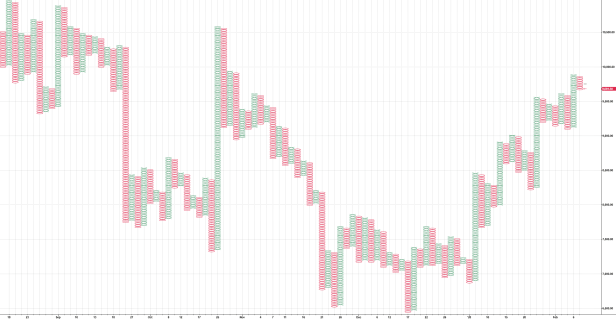
I decided to write this blog after writing one for work by request; Why Charts? Actually Wy Charts, because in crypto we say Wen Lambo, but you get the idea. It got me thinking about these time series charts. Maybe this crazy advanced audience needs to slow down and even back up. I think the chart I’ve used that may actually provide the most value is the good old Point & Figure chart.

There’s actually very little creativity in the crypto world, to be honest. Fundamentally, it’s mostly sentiment driven. Bitcoin goes up or down on sentiment. Everything else goes up or down with Bitcoin. So it’s sentiment. And when it comes to charts, it’s pretty much all candlesticks all the time. Funny thing to me is there isn’t a lot of discussion of candle patterns on candle charts. It’s mostly limited to a couple of momentum indicators, MACD and RSI, Bollinger Bands for volatility, and the always quoted, rarely understood Elliot Wave patterns. Oh, and Fibonacci retracements. There, I think I’ve covered most of it. Add in a trendline or two, and we’re looking at a crypto chart. But if we’ve simply put these artificial rollover points in there, is there truly value beyond a self-fulfilling prophecy?

A Point and Figure chart doesn’t care about time. It doesn’t care about Monday or Thursday or New Year’s. It cares about price. In the end, price rules. Indicators are merely derivatives of price; with volume mixed in occasionally. But if price rules, then what we should be focused on is just that, price. How the market moves and reacts. Time be damned. Because while I’m sleeping someone on the other side of the planet is trading. And vice-versa. And of course the bots never sleep. So I think we need to stop trying to be so smart and focus on K.I.S.S. Keep It Simple Stupid. Let some guru draw Elliot Waves and pontificate about the way they’ve quantified the market’s moves and its future. And another person can draw pretty trendlines. That’s fine.

XBT PnF

I just want to make money. That’s what being right is all about in the trading biz. We’ve certainly covered that before. So when looking for an edge, don’t depend on someone else. Don’t even depend on time if it doesn’t matter. Find a way to picture price and act on that. And the simplest way to picture price without a watch or a calendar is with a Point and Figure chart. They’re out there. Learn about them. Then try it out. Get back to me with an opinion. I’m guessing that the best new thing you’ll find is one of the oldest tools available.

I Thought I Was Always Right

Lebowski Customer Service

With virtually every topic I’d like to write about needing to be influenced by political leanings, I’m going to write about something that I’ve been saving. I’ve been saving it because I think it’s always a timely topic, but as I’ve revealed my bias for the light in our economic tunnel being a freight train coming our way that will lead to market declines and economic ‘issues,’ I do think that this topic will become more prevalent in discussions when (if) that time comes. What’s this topic that’s always pertinent but not always top of mind? Customer Service. Yup. We all deal with it. And our allegiances are often tied to it. Ever heard of a little company called Apple? That one was rhetorical.

So let’s delve a little deeper. We all have lots of Customer Service stories to share. In fact, my friends and family affectionately refer to me as the ‘Consumer from Hell.’ Why? Because it’s rare that I don’t get the satisfaction or relief I’m seeking. But I’m also pretty relentless. I’ve had to deal with some of the larger global companies recently, and it’s interesting to see the differences in approaches. Even beyond these minimal experiences, it’s simple to see the differences in how various companies interact with, and I’d say therefore value, their customers.

One company that I’ve only been on the company side is Bloomberg. Many clients stuck with Bloomberg, and its price tag, largely due to the company’s approach to clients. Bloomberg was known for many things; the depth of its analysis on the Terminal, the quality and breadth of data, and the amount of attention you could command as a regular paying client. It became policy to visit clients on a regular basis. Yes, even the ones in the middle of nowhere. Call in with an unsolvable question about a company, industry, or just functionality? Someone would spend hours figuring out which functions to give a detailed explanation of, or build you a custom spreadsheet, or come to your office and walk you through the best path to the information you were seeking. That alone could help a firm make enough extra money to pay for the subscription. And Bloomberg thrives, through good economic times and bad.

As a consumer, I’m amazed at the level of service provided by Apple. To be clear, I’m not an Apple guy. I always feel that I can get the same level of technology for less money. My daughter, however, is the other side of that. She is everything Apple wants her to be. What’s everything? Loyal. And for years I would tell her that everything Apple is overpriced for what’s inside, that there was probably a planned obsolescence factor that could cause her to spend more in just a couple of years, and that really she was more joining a cult than making informed technology decisions. And yet, because of my own recent experience, I’ll probably get my first iPhone when I upgrade next for 5G. All due to the way they interact with me, the consumer.

And here is where we get to start looking at the difference between good and bad customer service. Why? Because like everything else, home refurb’s, vacations, or just going to dinner for a special occasion, technology decisions are based on the level of confidence you have that the choices you make will treat you well in good times and bad times. Heck, you’re betting they’ll even still be there.

I’ve run into the negative side of this situation twice recently, with companies that will survive the next recession I’m sure, but how wounded do you want to be? I don’t own an iPhone. My phone’s manufacturer isn’t any fruit name. They are big though. And when my phone died while still under warranty (as any phone can), I was without a working cell phone for 2 ½ weeks. Now I remember living without a cell phone way back just a couple of decades ago. And to be honest, after the first few days the experience was a bit liberating. Except(!), no Uber. No parking app in Hoboken to be able to park my car legally. The list went on. Things we now take for granted are tied to our cell phones. So along with the liberating feeling, I kept asking myself, “2 ½ weeks? Under warranty?”

In fact, I went to the company’s US headquarters to try and get anyone at the company to actually take an interest and help rectify the situation.  When two employees happened by and listened to my tale of woe in an attempt to help, I explained that when there’s a problem with my daughter’s Apple anything, I can walk into a mall, drop off the iSomething, shop, eat, and 2 hours later go home with an iSomething that works. Fixed, replaced, whatever. My satisfaction as a consumer is the top priority. These employees from that ‘other’ manufacturer gave me understanding looks as one remarked, “Yeah, I hate when I have to deal with our Customer Service.” And they work there!

Airlines are famous for this, and I was recently affected by that as well. The comments I kept repeating as I moved up the ladder of employee titles were “I know I don’t have many choices when flying, it’s a shame you lean on that,” and “How would you feel if you were put in this exact situation.” When I asked these questions, I got answers that were nothing short of arrogant and patronizing. It amazed me that I was treated as if I was lucky to sit on the plane. We all know that air travel is not what it once was. Nothing is. But this level of condescension toward the customer is not what builds great businesses. Loyalty builds brands for the long term. And loyalty is earned, much like trust. Difficult economic times come along, and sometimes that’s too late to change your approach. That’s a problem.

Econ 101 teaches it’s cheaper to keep a customer than to get a new one. This is not old econ or new econ. It’s basic econ. But good economies breed a level of hubris that kills companies when times change. I’m not an Apple fan, but I don’t doubt people will overpay for their technology. Heck, in this day and age of Python programmers being a dime-a-dozen, the analysis tools on Bloomberg are overpriced too. But Apple stock is at all-time highs, and Bloomberg Terminals sit on well over 300,000 desktops. And Apple and Bloomberg will survive the next recession just as they survived the last; through loyalty.

These tough times will come. Cycles, pendulums, they’re always at work. So are the employees at Apple and Bloomberg. We’ll remember that. We’ll also remember the employees and attitudes at that other phone manufacturer and that airline. And as has been proven time and again through history, the consumer will speak with the loudest voice they have; their wallets. Stay tuned…

Let the Games Begin

So the Fed cut rates ¼ point. Makes the topic easier, even though I was ready to write about customer service. Not to bitch, but to try and remind people of that lesson learned first semester in Economics; it’s cheaper to keep a customer than to replace one. I can write that one anytime. This one, well, I can’t help but address.

Before I dive in deeper, yes, last time I wrote about the S&P going down and it went straight up. Got stopped out. I’m OK with that. It’s why I use stops, because my opinion has not changed, but the market let me know I was wrong at the time. So I’ll wait for another opportunity in the market that jibes with my opinion. While I generally try to be agnostic except for what the charts tell me, I just can’t get long. But I will listen to my charts and I won’t go short. And this actually provides a good segue as we discuss The Fed…again.

The feedback (opinions) on this move are mixed. There are some (a couple on The Fed, outside analysts, me) that believe this move was supported more by political pressure than by economic need. And that’s what makes a market go, differing conclusions and opinions. What makes a market go up is a President nearing an election for a second term. At least that’s my perception. And I’d guess, that when they don’t go up in that election year, it’s not for lack of effort on the part of the President. I’ve heard others voice the same thought, and so I figured it was time to look at the numbers; do sitting Presidents really have the ability to affect a market and is it something they actually do?

Let’s think about this. We need to start with an assumption (there’s usually at least 1 assumption, no matter what we say about the word ass-u-me). That assumption is that people vote their pocket books. In other words, all the idealism vs realism (the party in power is always “realism”, the other is “idealism”), none of the talking points or campaign platforms, promises, etc. actually make a difference. We all talk about lots of issues but then we also base the final decision on the same single issue.

If people are feeling “comfortable,” if they think that their finances are in decent shape and are optimistic about their own personal economic future, they will vote for the incumbent. After all, that must be the person that’s responsible.

And what are most people equating with this economic status? I say the Dow Jones Industrial Average. Not the S&P 500. Not the Russell 2000. Not the strength of the US Dollar (unless planning a European vacation). Possibly interest rates, but only for those buying cars and houses. In general, over time, the Dow has been what people have looked at. And much of that is habit, it’s been around since before the beginning of the last century. Also, simplicity. There’s less thinking involved because it’s quoted constantly, so therefore it must be the most important benchmark.

I traded commodity futures in the pits for almost 14 years. Then I traded those same futures instruments for another 10 years. And to this day, my mom wants to know “what did The Market do?” What she wants to know is was the Dow up or down. Thirty companies. That’s it. But it’s easy, and it’s been around. Think about how long it’s been around. It’s been around for the growth, and the decline, of many of the industries that so many people in our country participated in. Many had their futures staked in pension plans. And those pension plans invested in Blue Chip stocks. So as went the Dow, so went their futures.

Think about that. All it takes to win re-election as President of the United States is for the Dow to go up. Do they have the ability to do this? I’m not sure. But as a gold bug, a contrarian kind of guy, I love a good conspiracy theory. And I do believe that with a nudge here and a poke there the market, the Dow, might do a bit better than it otherwise would. A contract award. Some infrastructure work. A trade deal. That’s all. And yes, it’s all for the better. But it still makes me wonder whether our elections haven’t been used as a tool by candidates for decades.

These are beliefs I’ve had for a long time, more as a Political Science major than as an Economics minor. So I finally decided to look at the numbers, because if I’m going to get stopped out of my shorts, I might as well look deeper at “The Story Behind the Picture.

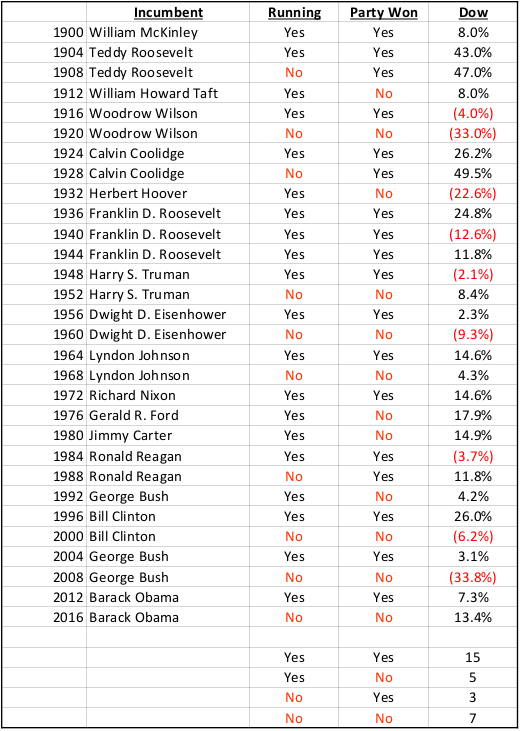
The Dow Jones Industrial Average was first published in 1896. Back then it was only 12 companies. But it was 12 blue chip companies. It was the gauge of the economy and whether people were happy or not with the current president to re-elect them. I went back to 1900. The Dow was 4 years old. A Presidential election cycle. Perfect.

Presidents

Since 1900, there have been 30 presidential elections. In 20 of those, a President was running for re-election. In 15 of those 20, the sitting President was re-elected. Within those 15 re-elections, only 3 times was there a negative return in the Dow. On the other side of the math, we can look at the 10 instances when a sitting President was not running. Only 3 times did the same party stay in office. Lack of motivation? Lack of interest? Thinking about where the Presidential Library should be?

I am generally the first to point out that Correlation does not imply Causation. And as someone who has gotten stopped out of many trades, I’ve learned this first hand. I learn from all my losing trades. Much more than I learn from my winners. And the point of this blog is to provoke thought. Really to simply present a perspective in the hopes that along the way people will learn at least something. So for me, what I learned from my losing trade is that I should always remember to process as much information as I can before taking a position. And the information that I didn’t include in my analysis was something that I’ve said for years. Don’t bet against a bull market when someone is seeking re-election. It’s not 2020 yet, but it’s close. So I’m flat. I think I’ll just watch for a while.

Just Chillin’

I wasn’t sure what to title this one. I do try and find something that I think will catch people’s attention and get them to at least start reading, and wasn’t sure if the one word topic I planned to write about would be enough. Complacency. It’s one word, but it communicates a lot. One definition includes, “a feeling of quiet pleasure or security, often while unaware of some potential danger, defect or the like; self-satisfaction or smug satisfaction with an existing condition, etc.” Let’s think about this, as there are two parts to that sentence and I think we’re experiencing both of them across much of the investing public, and the public in general.

I flew to Florida recently to see my parents, and started thinking about this at the airport. I was more convinced once I was there. And as I noticed my charts showing some ugly S&P patterns, to me anyway, the idea of writing about complacency seemed obvious. “Why all the negativity?” you ask. After all I’m the guy that’s called all the sell-offs healthy corrections, even though every one of which seemed to be, at the time, the ugliest one yet. People were pretty happy and even complacent then; so what’s different? I’m not going to go into yield curves and all that again. What I am going to do is try and explain why I keep getting more reinforcement that something’s different this time. And if I’m wrong, and we just start another huge leg up, I’ll chalk it up to another wrong call among many in my career. But I’ve got an argument and a perspective (Bill’s favorite word) that I’ll stand behind should the same set of circumstances arise again…even after that monster rally, if and when it appears.

Complacency to me, in part, shows itself when everywhere I’m going I’m seeing new big stuff. Now, I’m a huge believer in the need for infrastructure rebuilding. And I’d be super happy if it all were to start at the same time. That would be some good new stuff. And New York City and everywhere within commuting distance has lots of new stuff; big stuff. Why do I worry? Because it’s not those infrastructure types of big things. It’s things like houses. Lots of small independent contractors buying a house, tearing it down, putting a new one up and selling it. Lather, rinse, repeat. Keep on doing it. The problem is that in these cycles we reach a point where the market can’t support the constant price increase in real estate, and the music stops. Many of these small independents roll all the profit of the last one into the next one. Or like so many of us, put the extra money they find in their pocket into their own house. Either way, we don’t save it. And if the music stops for one of these contractors, they’ve now got a second house, with a second mortgage, and not much in the bank. And all the stuff goes with that market…Appliances, cars, pools, vacations (getting to that…).

The airport also had lots of new stuff. New terminals. With a bunch of new high end stores and restaurants. And crowds in all of them. People spending. I like good times. I was a trader during those legendary fun times. But when everyone is spending, well, I’m a contrarian after a while. And there was no sign of it letting up, from what I saw at Newark airport. Lots of vacation folks. Filled business class seats. Even went to Cabo recently. I don’t think that plane was packed with people needing to fly for business. And the number of new resorts being built was pretty amazing too.

Complacency. You don’t build a new resort when you’re worried people will stop spending. All this fun. And interest rates are still pretty low. The job market is still strong and seemingly getting stronger. We do have it good! And we’re paying little attention to any signs that this perspective of having as much fun as we can, with little regard for spending or borrowing, will end anytime soon. But aren’t we embroiled in at least one trade war? Isn’t there instability (re)building on many international fronts? Aren’t interest rates acting weird? Oh, that one…

Complacency. Many of the most listened to people in finance are saying this time it’s different. There are explanations that the state of the yield curve won’t have the same impact this time. Hmmmm…all these things are lagging indicators, therefore it’s not the yield curve that actually causes it. So the argument extends to saying that the causes are different this time around. Sounds like a New Normal. We’ve done new normal before. Internet bubble. Companies can lose money and we should still buy the stock. Wait! Anyone heard of Lyft and Uber? Sigh…

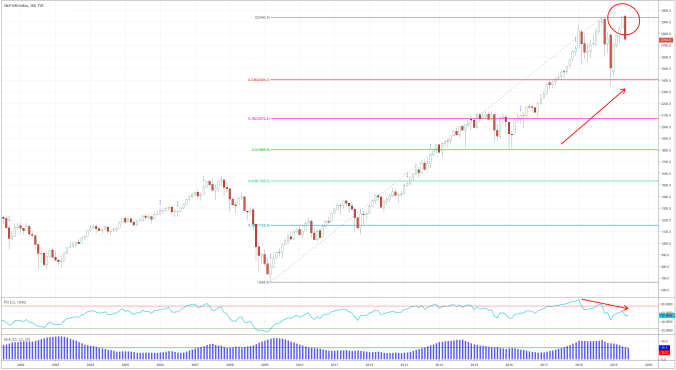
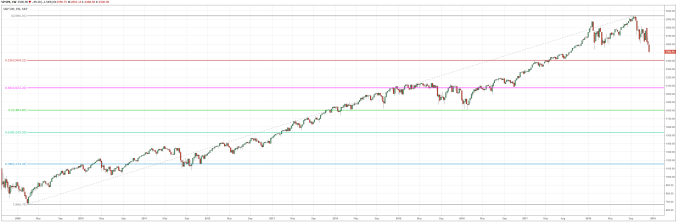
We can, if we want, look at why I find that S&P chart particularly ugly, since that’s why I think this time’s different. To begin, this is a monthly chart. Remember when I talked about waves and tides? Well, a monthly chart is that tide pattern that rules all the waves. So when the monthly shows something, we need to pay attention. To briefly summarize what it’s showing me; barely making a new high and with no follow through, no positive momentum in the last move up leading to a “divergence” between price and momentum at the top, a bearish engulfing candle at the top,  with all current momentum pointing to declining price.

SPX Monthly 20190531

That’s a lot of stuff. Just like the other “lot of stuff” I’ve been harping on, but a different kind of stuff. Stuff you don’t want to see all together. After all, it’s easy to say one indicator doesn’t really tell the story. It’s easy to say that a couple of indicators can’t always be right. But there are a number of factors coming together here that disproving one or two still doesn’t easily negate the overall argument. And those that are denying many of these things (or worse, not even listening), those that would preach this time is different, that this is a new normal, are demonstrating complacency at its best…or worst. Those who forget history are doomed to repeat it does not just hold for countries and wars. It’s a big factor, I believe, in market cycles as well.

Now obviously, I’ll be right eventually. Like broken clocks twice each day. And I accept that if eventually takes too long, that’s the same as being wrong. But the last time I felt like this was at the top of the internet bubble. People were pretty confident it would all keep going. But all my charts said ‘Sell.’ The person I was working with kept saying ‘Buy.’ For years I’ve told that story and said he was wrong. Looking back now, I think he was just complacent.

What’s Going On? Tough Question

I was thinking about how long it’s been since I posted, and thought, “This is no way to keep people interested.” Then I realized I was merely following the lead of the British government and simply kicking the can down the road, on a continual basis. People are still very interested in that, after all. In my case, the delay was two-fold; first, I was struggling for a while writing a talk that I delivered at The TradersEXPO in New York recently, so I was handling all the authoring I could. Second, as usual, just pondering what to write.

And then I finished the talk, and got hit with a topic. Funny how it all comes together at once sometimes. So what should we discuss this time? FUD. Fear, Uncertainty, and Doubt. For the most part, I think people associate that expression with crypto, which is not an unjustified perspective, given all the “shit coins” (pardon the old floor trader language) that have been issued over the past 1 ½ – 2 years. But in this case, it’s those old boring bond markets. What to do…

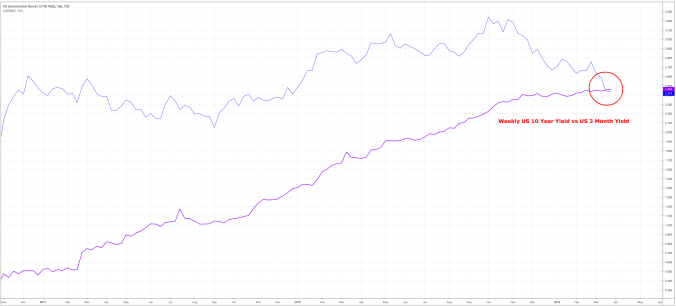
Over two years ago, I wrote about interest rates. I said once they turn, they maintain that direction. And yet here we are, the Fed saying no more rate hikes this year, and the bond market telling us it’s not happening anytime soon after the end of the year either. The headlines are there. One said maybe the Fed will actually ease rates again. Some spoke of the Dow sell-off as a result of the 10 year yield crossing below the 3 month yield. Inverted yield curve it’s called. What it means is that the long term prognosis isn’t as rosy as it should be given current shorter term rates.

10 Year vs 3 Month

The headlines aren’t confined to the US. German 10 Year yields dropped below zero for the first time since 2016. When rates were zero everywhere. If Germany is worried and having economic worries, so is the rest of Europe. But what about all that talk about cruise ships and speed boats and interest rates were going to keep going up once it began? I’m speaking of my own writing 2 years ago, of course.

Wrong; and I’m going to go with a simple theory. This is something that I’ve brought up previously, though not in the same context. People hate uncertainty. Markets hate uncertainty. Not knowing what’s going on is worse than knowing what’s going on, even if what’s happening is not to your liking. At least you know what’s happening today and what will most likely be happening tomorrow. We don’t seem to know much these days. We have a trade war. We have factories closing and opening. We have countries figuring out their lives. We have lots of questions. And that’s when we can end up with problems.

Did I mention the US government shutdown? I didn’t. That one isn’t a question. That one’s fact. The US had over 10% of its workforce unemployed for a number of weeks…over the holidays. Can’t be a good result, and certainly plays a part in our current situation. And that situation is a lot of uncertainty, and an economy whose strength we were recently discussing and that is now, possibly, headed in a recessionary direction.

Fear, Uncertainty, and Doubt. I sure do hear that one a lot! Stay away from the crypto world. It’s fed by this! You can’t trust it. Yet here we are, with crypto markets exhibiting historically low volatility, and everyone questioning WTF is going on with global economies. Pardon me a moment, I need to chuckle quietly to myself…

Better now. This is interesting to me, as I rarely know what’s the dog and what’s the tail in markets. We’ve already learned that’s why I use charts. Don’t need to know, just need to act. But that’s not what the blog is about. The blog is actually about, “Is the dog wagging the tail, or vice versa?” And here’s where I start reaching, but hopefully generating a bit of thought. I reach plenty. Like when I said not to laugh at Trump becoming president when he first announced and late night was making jokes for different Trump reasons. People thought I might be reaching then too. So, yeah, stuff happens. And we can only move forward.

So why do I wonder which is the dog here? Because there are a lot of fundamental reasons for the markets to be confused and a bit spooked perhaps and it’s manifesting in bonds. But if we continue to believe in cycles, and pendulums and other previous discussions, then we need to look at a long time equity rally and wonder if the cycle is ending, no matter the news. So perhaps FUD is merely the excuse. Maybe overbought conditions at some point have to catch up. And maybe, actually, that was leading the movement. Wait, what?

Let me take a shot here. Again, something to ponder. As always, I’ll wait for charts to fully convince me. I’m not there yet, but I am getting closer. Equities may be done, for now. First time I’ve said that, and maybe, hopefully, they aren’t. But if they are, it will happen as we go towards recession. If the economy begins to accelerate again, all bearish bets are off. For now, though, there are some warnings, and they begin this time with FUD.

An on again, maybe off again trade war. A on again, maybe off again Brexit. People just want to know how to plan. Not so much to ask. They plan their mortgages. We can spend this much on a house for 30 years. They plan for college, or at least try to (talking in real time here). Anything can go wrong with uncertainty. On a household level? Medical costs come to mind, but that is an entire blog chapter by itself. But on a larger scale it’s, “When will the government shutdown end?” “Will I lose my job if the trade war continues or will it be good for me?” “Is my country part of the EU or isn’t it?”

It’s really tough to invest for the future when questions like those hang over a person in the present. Because when investing for the future, we know the present is the only real information we have to go on. And when that information is vague, or worse, full of result possibilities bordering on opposite extremes, it’s that much worse. It is, in fact, the hardest. So how to adjust? Watch the charts. See earlier signs of large directional continuations or changes. Use tight stops. Hmmmm…bonds or crypto? Both.

So Now What?

Well, it’s been a while. And in that while, I keep getting asked the question, “So now what?” The interesting part about the question is that I’ve been getting asked both when it comes to bitcoin and cryptocurrencies, as well as related to traditional equities. If everything is down, and in this case down is certainly relative to the specific market, how can we be anything but fearful about the future of these markets. However, if you’ve read at least a handful of my blogs, you know that I believe in the influence of cycles, crowd behavior (sentiment), technical analysis (self-fulfilling prophecies), and plain old fundamentals to drive the markets, not to mention perspective. I like to think of it as taking a step back, looking for the bigger picture, and filtering out as much “noise” as I can.

We can start with equities. Certainly has been an ugly few weeks. But is all that terrible action really the beginning of the end? It could be, but in my own analysis I don’t see it. What I do see is an acceleration of an inevitable correction. Everything negative seems so much at the forefront of our thinking, both economically and socially, that we don’t seem to ever see the “silver linings” we’ve heard about our entire lives. Markets don’t just go up. The good news is they don’t just go down either. Every uptrend I’ve ever seen has corrections. And every down trend? The same. But it never feels like it when you’re going through it. The feelings of joy and misery these market moves bring influence our every decision. Welcome to what we’ve signed up for; the struggle to balance fear and greed and come out in the long term better off than we were before.

So how do we handle this? “The rich get richer” is often muttered after we look back on difficult market times. It’s not just because they can double down and invest harder in down-turns, understanding that this too shall pass as we go through economic cycles. It’s the ability not to panic. To understand that while today I may have less money than yesterday, sometime next week, or next month, or even next year, I’ll have more money than I had those same days, weeks, and months ago. It’s how it works. This has been a heck of a rally. People are shopping. Homes are selling. Interest rates have gone up for the right reasons.

Are there obstacles? Sure. We’ve discussed trade wars. They’re generally not a good thing. We can go into manufacturing, head-quarter locating, infrastructure upgrades. Good things are happening but getting less press. There is a need for us to find the value of the good news and ascertain the actual impact of the bad news to truly analyze what we’ve got. Grab a chart and understand that nothing goes straight up, but it’s awfully early to say it’s the end. I’m going to err on the side of the people that historically make the most money. The ones that really put their “money where their mouth is,” and not panic out because someone on television is talking their position or finding a way to get air time by being negative. Notoriety is not what moves markets. Real facts move markets and I look to my charts to filter those facts. Doesn’t look that bad from here.

SPX 20181219

But what about bitcoin?? What about crypto? I’ve written numerous times about crypto, and the need to explain it every time the news is big enough that even my mom is asking. So now my mom is asking, “Is the crypto market over? Was it really just another bubble?” It’s my mom, so the answer has to be more than just a simple “No.” There needs to be some sort of reasoning behind a statement so opposite to what markets, and commentators, are telling us. And as I try to do as often as possible in market analysis, I’m going to draw on history for my explanation. While many are saying, “Well, over the past few years it’s still a great return,” this isn’t where I’m going to go with this one. After all, we wrongly think of markets in hours, days, or maybe weeks when thinking about returns, so how can we now pull this 2-year argument out of our back pockets? Doesn’t work in reality, and I get that. And it is down…a lot

So what do I have to say to those that want to tell me the crypto “revolution” is over? I say I’ll go back and look at history…again. It’s what I do. Generally using charts and pointing out repetitive behavior over time, but also the fundamentals behind that repetitive chart behavior. The Story Behind the Picture! It’s what this blog is all about! So what’s the story behind this picture?

XBT UPnDN

In my memory, the not so distant dot com bubble comes to mind. And in many ways it was a bubble. People invested blindly in things they didn’t understand. Often it was because there was nothing to really understand. Hype. Companies coming to market on loose promises that they had no idea how to deliver! Hmmmmm…oh yeah…crypto ICO’s! Ever heard the term “I’ve seen this movie before?” It comes from situations like these!

Did the Internet die? That’s rhetorical because you’re reading this. Did a load of companies, with nothing to offer but empty promises of stock riches based on plans they couldn’t execute, come to market and make founders millionaires at the expense of innocent dreamers? They certainly did. And they temporarily killed the equity markets. And then something happened. The promise of the Internet began to actually manifest itself in our everyday lives.

I do believe it’s similar with crypto. The basis of its existence, blockchains, is our newest phenomena that’s spurred a temporary investment bubble. The value of blockchain technology is not about to vanish. Like the value of the Internet didn’t. Microsoft, Amazon and Apple are the most valuable companies around. But why is it so easy for scammers to create bubbles in these times? Because there really is something of value, something world changing behind it. But there’s a painful process we’re going through. We’ve been through it before. And at some point we’ll go through it again. Wait…will that be traditional equity markets or revolutionary arrivals that change society? Another rhetorical question; the answer is “Both.”

Thank you to everyone who’s taken a little time to read these this year. Wishing you a happy, healthy, and profitable 2019.

Tick Tock

Pendulum Clock

I’ve had discussions with people on many different topics over time that often end up with me, at some point, making a comment about pendulums. Those things hanging from the beautiful mantle clock, or grandfather clock in the hallway. They seem to explain so much that we live through over time. I mentioned the word briefly in a blog entry almost 2 years ago, and haven’t taken the time to revisit the term, though maybe I should have. Because whether it is in social norms, politics, or where I prefer to focus – the markets – the pendulum effect is in full force.

What is the pendulum effect? I’ll start by saying though I’ve never heard the expression nor the idea as a real ‘theory,’ if it does indeed have validity, then I’m sure it’s been written about before…in actual text  books. To me, the idea of a pendulum effect is that almost everything we live through and have an opinion about, seem to act like pendulums. I think in many ways, in many situations, the ‘true’ majority would really find a center point the place they would like things to eventually settle. I don’t think most people are at the extremes of the loud people. And while it sure sounds as if this is about to get very opinionated in a way that doesn’t serve the purpose behind these blogs, actually it was things like GE and the continued threats and implementation of increased trade duties that drove me to write this.

This all comes back to the idea that in the end, markets are driven by emotions. Emotions turn people into lemmings. It’s why it’s so much easier to buy high and sell low than to do it correctly. Because it isn’t in our nature to be market contrarians. Even many contrarians are only contrarians in speech. When it comes to acting, they still do what everyone else is doing. Why? Because people would rather be part of a large group when they’re wrong. They don’t feel as ‘dumb.’ It’s often truly more important than just being right. Be in the group…

When I was at Bloomberg visiting clients on a regular basis, it amazed me how many institutional traders just wanted a way to be sure to buy or sell no worse than VWAP. VWAP is the Volume Weighted Average Price. This is the average price that, theoretically, most of the trading takes place. And that’s what traders wanted. They wanted to be Average. They strove every day to be Average. Just like general crowd behavior, they were able to explain to their boss that they weren’t any worse than others. This out-weighed the reward of possibly telling their boss they did better than the crowd.

And that’s the pendulum. Average. Where we really strive to be. We don’t like extremes, because the risk is that the extreme is the one on the other side of ours! I’d love for all of the important decisions in the world to go exactly my way, but they won’t. So I’ll accept them not going completely my way as long as I know that they’re not going completely your way either. It’s an equilibrium. An equilibrium we rarely see.

In society we call them liberals and conservatives. And many long for a time when they actually spoke to each other and found a compromise solution. The middle of the pendulum’s arc. I learned early on that a successful negotiation meant everyone was happy, but not too happy. Don’t get those kinds results much anymore. It’s more an imposing of the wills. Corporate management wins or labor wins. We don’t all win (and lose) anymore. And then the losing side gets angry enough about it having happened and they end up finding a way to swing the pendulum too far their own way the next time. “Overextension.” Just another market term.

Brings me back to GE. Being the largest conglomerate in the world was an excellent thing. And now it isn’t. Jeff Immelt was setting an example for others to follow. Until it was deemed a model for others to avoid. So the sale, or even fire sale, of many assets shows a pendulum actively swinging and picking up momentum in the other direction. Bulls and bears. We have big bull moves, we have big bear moves. Occasionally we get sideways equilibrium, the middle of the arc of the pendulum so to speak, but we end up swinging through that point and find ourselves Overbought or Oversold, again.

The thing that I try and do is to be conscious of this as much as possible. Does it make me happier when things go the opposite way? No, but it gives me perspective. The perspective that in due time I’ll see the pendulum at the apex where I’d like it to stop, and then it won’t. It will end up all the way on my side of that swing. And if I keep my perspective, I’ll realize that this state will only hold up for a brief period. And then it will swing the other way.

Democrats grab a majority, Republicans revolt and the majority becomes theirs. Then the Democrats revolt and the cycle repeats. Just replace Democrats and Republicans with Bulls and Bears. It’s a natural pendulum at work. It’s what keeps the markets in balance over the long term. As many times as the word cycle is used in analysis of securities and markets, we really should be looking at those market moves as a microcosm of the cycles we choose to live every day. It’s the discipline of making sure you keep the overall perspective that “This too shall pass” (and maybe even preparing for that inevitability) before you follow too many lemmings off that bull or bear cliff.

I’ll Show You Mine If You Show Me Yours

united-states-wage-growth

Much of my professional life has been spent self-employed. The idea of comparative salary was never a question or an issue, particularly as a trader. When someone is self-employed their salary is of course tied to the success of the business. Even so, many business owners will take a salary or draw of a steady amount and let the business build value over the years. I always thought that trading was a bit different, especially in my days as a market maker. Every day I made or lost money, and my ‘salary’ would ebb and flow with my trading success.

I’ve now spent the better part of the last dozen years or so in more traditional salaried roles. And that’s been great. The mortgage is covered, and there is much more predictability in life in general with this situation. The earliest part of my professional life was like this as well. Back then, early jobs out of school ‘never paid enough.’ But actually, they did. Again, rent, bills, and maybe a bit left over to go out on Saturday night in Hoboken or New York City. It was fun, and we always knew that some friends made more than others, though not always which one.

And that’s always made me wonder. To this day salary, or remuneration in general, is a pretty well guarded secret. I do it just like the next person. In fact, laws have popped up in some places that ban employers from asking prospective employees what their current salary is during job interviews and initial salary negotiations. When looking for a job, people will tell recruiters, “My previous salary is not important. I’d like to be paid fair value in whatever role I find myself next.”

That statement makes sense to me. When unions were more prevalent and powerful in this country, an entire class of people and the majority population in many cities all knew each other’s income. It was part of the group contract. This still exists on some level, but outside of the specific group of workers, the pay scale is often not easily discoverable. But why?

Competition is a good thing. I’m a trader at heart, and much of that is a competition of sorts. There are survivors (winners), and those who lose their money dedicated to the markets (losers). I can say that many of the people I’ve worked with in trading environments will wager on almost anything. So it’s a competitive universe. And these days, so is everything else.

The job market is extremely strong we’re told. The numbers demonstrate it. And outside of some pockets that should not be ignored (‘ceilings’, age, etc.) , it feels different than it did a few years ago. Yes, it’s all part of the cycles I like to discuss, but the majority of job postings will not list a salary. Why? Because as both sides are feeling happy when someone is getting a new job, that employment situation often starts out as a competition between employer and employee. How little can we pay a good prospective employee? How much can I get out of this company for my qualifications and abilities that I’ve been bragging to them about?

Maybe it’s just me, but if the warm and fuzzy “We’re on the same team” idea doesn’t seem to be present at the outset can it really get better from there? Or are we just sitting there pretending to love each other when in fact we’ve both got knives in our hands as we hug, ready to stab the other in the back. Now this part is inherent. If you don’t own the company, and even if you do, you’re first priority should be your family, not the company. But why all the secrecy? Even in sports we disclose information about salary structure, and sports are by definition usually a competition.

In much of Europe, salaries are public. If not by law, then by practice. Does this make for a less effective work force? That’s a pretty rhetorical question. The answer is obviously no. So why do we do this? Our society currently breeds more stress than it ever has. Just ask any high school student. My daughter is entering the “look at colleges” phase of early junior year. And it really doesn’t get any easier. I do think the overbearing stress used to start later in life though. And then comes the job market. As my good friend told his son upon starting his first job after college, “You don’t get ‘breaks’ anymore, you get a few weeks of ‘vacation.’” Bit of a rude awakening.

I’ve done salary negotiations. And follow up discussions with colleagues. I always just want to blurt it out. This is what I make. This was my raise. How about you? I don’t want to have this discussion in order to brag. Or in order to set myself up for a letdown. It’s actually more for ‘level-setting.’ If we’re all supposed to be on the same ‘team’ at work as we’re often told, then why not just be transparent about all of it. That is, after all, one of the new catch phrases.

Transparency. Ha! The most important part of working for all of us is getting paid, and in that respect there is little transparency in the United States. What we’ve got is a set up pitting ‘team members’ against each other. The ‘bonus pool’ is a great example. So is ‘Stack Ranking.’ Setting up your team members from top to bottom to determine who should get the large bonus and raise, and who languishes on the bottom. It’s easy to do when there is a veil over the whole thing. I won’t go into age discrimination, but the source of that is trying to decrease salary paid for a job done, and it’s so difficult to prove due to the secrecy companies have bred into the work force.

I say we follow the model that works elsewhere. Month long summer vacations worked elsewhere for a while too, I’ll save that for another chapter. For now, let’s practice transparency. Let’s take some of the ‘angst’ out of our professional lives. Let’s all find out what being on a team is about. Superstars can still make more. They do in sports. We all know what LeBron gets paid and he deserves it relative to the market. That’s ok. It will work throughout. I’ll start! My salary is $X, with a $Y bonus. See ya at the annual review.

Black Gold

As someone with a fascination for politics, markets, trends, and everything in between, this blog chapter was an interesting choice. While I’ve had more difficulty finding things that strike me as interesting in between all of the back home politics lately, the Italy story was certainly appealing. After all, while it’s rare that Italian politics and the possible ripple effect on markets can’t be a story, currently we’ve got one of those situations where all of the financial media is paying attention. So that weighed on my decision. But when it came down to it, the market dynamics often at work in the Crude Oil market won out. Perhaps an Italy chapter is not far behind, but for now, let’s talk oil…

I’ve told many people many times how unsuccessful I was as an automated, program driven crude oil trader. My work on trading algorithms often showed a great amount of success in every market…except oil. This was something I finally gave up on rectifying. The reason? I realized that crude did not lend itself well to my style of trading and model design; it was a market that spent more time in mean reversion and little in trends. For me as a trend follower, success would obviously be limited.

This is not to say crude oil doesn’t experience trends. It absolutely does. It’s a commodity after all; no commodity has a true shortage of trends. Nature, human psyche, etc., they all contribute to trends and cycles that have been successfully observed, interpreted and traded on for decades. Lots of decades. But then why the lack of success in crude oil trading? It’s because, as far as I can tell, crude spends much less “time” in trends. While time is in quotes, it really is time in the classic sense of the word. When crude has a large move, it is generally short lived, and often violent.

It goes up hard, it comes down hard. But in between? A lot of sideways. So this was not a market I was going to have long term success in. While a bunch of money could be made in each of those large trend moves, the periods in between would erode all of the profits, and in my personal models, even a bit more. Which brings us to now.

Crude cropped

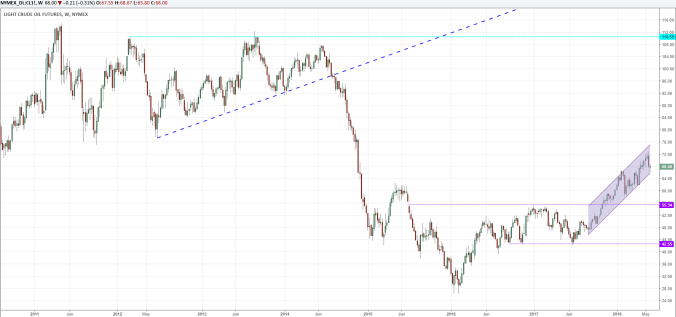
The crude chart above makes this pretty clear. At the top, we’ve got an ascending triangle. I’ve taught this pattern many times, and generally as it’s forming, one would have bullish thoughts. However(!), the reason we use these charts is to let the market dictate our actions as opposed to telling the market what it’s “supposed” to do. In this case, that level top stayed in place and we broke to the down side. The market didn’t look back and hasn’t since. However, paying attention to that break certainly made the direction of the market clear.

What it didn’t make clear was the degree and speed of the drop. This is not unusual behavior in this market. What I believe sets it apart from other markets is the swiftness of the trend beginning and ending. Yes this happens elsewhere at times, but it seems to be the way crude likes to move in general. And then it meanders to some extent. And that’s pretty much what it did for two years after making the ultimate low in 2016.

Where are we now? Inside a nice ascending channel bound by rising trendlines. What could go wrong? Mean Reversion, that’s what. The time this market spends trending next to the time it spends moving sideways will always weigh on my mind whenever I want to jump on the crude trend train. Usually by the time I jump on, it’s on the way to the last stop. This is not merely a psychological weakness, or even bad luck, it’s a market dynamic. So I’m wary…

It’s a tough spot to be in, and this is why we always look at the charts. Because while the dynamic of the crude market may make it difficult for me to program a winning trading model, it’s not something that is hiding anywhere but plain site. And it’s my own knee jerk reaction, “Crude is a mean reverting market,” that can stand in the way of profits when the trading decisions are not machine driven. These pictures may mess around at times, but they rarely lie. And that, if you’ve been searching, is the point and the lesson in this blog chapter; even if you’ve seen it “all” before, keep an open mind as the market progresses and the chart builds.

Keep in mind when making a “Plan” (always have a plan) that just like boring steady profits, boring markets aren’t all bad. If you’re a ‘quant,’ or even a ‘quant wannabe,’ you look forward to mean reversion. You bank on mean reversion…literally. So this market has something for everyone! And while all markets go through stages, up, down or sideways, crude’s stages are a bit different. Interest rates trend for years. Grains can trend multiple times in one year. But crude is where I’ve found the largest amount of sideways movement. And in this case, not a bad thing due to that level of predictability.

I’ve stated before that interest rates trend for years. And that predictability is good, given that so many of our long term decisions are interest rate based, or at least related. How is the economy doing overall? When should I shop for a house? All of these things relate not only to present, but to the future as well. Oil? Except for airlines, most people aren’t making long term decisions based on the pump. Short term? Sure. Should we fly or take a short road trip. It’s nothing like a 30 year mortgage commitment.

So we have opportunity. Opportunity to ride the trend, and opportunity to make ‘boring’ money with mean reversion. Sounds like a great market to trade! As long as you’re not trending when it’s sideways, or sideways when it’s trending. Be alert, be nimble, but mostly, “Pay Attention!” On second thought, that sounds like pretty good advice no matter what market you’re trading.

He Said A Bad Word

Circle of Life

“Inflation.” There, I said it. And I’m proud and I’ll say it again. Inflation. The thing that first comes to mind is the late 1970’s. Even if you weren’t alive, any lessons you’ve heard training you that inflation is bad mentioned the 1970’s. Of course that’s not the worst inflation ever, but it seems the occurrence that people can most identify with.

There’s no shortage of stories of double, triple, quadruple percent inflation. But generally it was war, or a downward spiral of a ruling regime, or a time that people try their hardest to forget. But not the 1970’s. That was just painful. Wages not keeping up with prices. Job demand not keeping up with prices. It seemed as if nothing could keep up with prices. And then it was squashed! In 1980, the Fed Funds rate reached 20%. That solved that problem. It brought on others, of course, but that’s for another blog.

By 1980, inflation was running at approximately 14%. Think about that. Prices were increasing on average at 14% a year at the peak. I can still remember the equation that money will double in 7 years at a 10% compounded interest rate. What we’re talking about here is prices doubling in under 5 years at that rate. When was the last time that your salary doubled in under 5 years for the same job? That was rhetorical. To anyone that was able to answer, we all want your job.

So that brings us to now. We’ve enjoyed extremely low interest rates for a while now. Enjoyed may not be the most accurate description for many, as these low rates are a result of the “Great Recession.” Low rates have been kept in place as people crawled out of the financial depths that many reached and have gotten back to the more normal existence of working, paying bills, and not being too stressed about losing the house to enjoy other things.

But like so many other things, we get used to it. We think it’s a “new normal” or something. But it isn’t. It’s a part of a larger cycle. The duration of these cycles is always difficult to predict, but still there are cycles. Economic cycles include low interest rates, high interest rates, and rates in between on the way up and on the way down. And when those rates start going up, it’s usually because the economy is expanding. Business is growing. Wages go up. Jobs are created. It’s…wait for it…Inflation!

Doesn’t sound so bad does it? It’s the other part of the cycle. And it has arrived. There’s been a bit of a rumble, but like so many cycle changes (think the recent winter to spring shift), it will come upon you all at once before you realize what’s happening. So how do we realize it’s happening? It’s evident in more and more ways recently, and there’s nothing we want to do about it.

As we’ve all read, the job market has picked up. For a while, it was easy to make the argument that we still weren’t accounting for all those people that had given up. But even those people are coming back. The lower end of the job market has become extremely tight. Part of this is no doubt an unintended consequence of our recent immigration stance. Part of it is the move toward higher minimum wages, and the ability for others to feel empowered to hold out for more. The number of small factors that can ripple out and impact this part of the labor force are quite large. And it goes in waves…

As to food, that staple we can’t give up, I would guess we’ll all start feeling that a bit more. I’ve been told by a friend who has successfully opened and owned numerous restaurants that his food costs are going up. So, it’s going to cost more to eat out. Of course, this will also translate into it costing more to eat in. And speaking of eating in, let’s talk about the ‘in’ part. Housing. Mortgages.

There is no doubt that this is where inflation will be felt quickly and impact a great many decisions. When interest rates jump, the housing market can experience a couple of things. One thing we’ll see this time is the rush to buy. That comfortable feeling of low interest rates has made the housing decision easier for many as they felt they could wait. The time wasn’t quite right, or the right house just hadn’t come along. Can’t wait now.

When rates jump, so do people. They jump into home ownership a bit sooner than they planned. They jump into a house that doesn’t quite check all the boxes, but it’s close enough. And get ready. Because this most impactful of inflation traits, mortgage rates, is about to grab you. In the last week, 30 year mortgage rates jumped 15 basis points (https://www.bankrate.com/mortgages/analysis/). That’s a lot. The warnings are that they will continue to accelerate. And this is during a period of low supply. That’s surely inflationary…

Obviously, inflation out of hand is definitely a bad thing. But the opposite can be as well. Japan has a recent 20 year history of low to negative rates that they would have happily traded for some expansion. Cycles go to extremes, and extremes are usually bad. But the up and down slopes themselves are not necessarily bad, or good. They are necessary. They make it a cycle. So now we’re in the inflationary cycle. But remember, it’s happening because people are getting jobs. They’re getting raises. Business is expanding. So while we don’t like paying higher prices or higher interest rates to buy a house or a car, we do like getting raises and having the opportunity to find a better job. And no matter how much we might want to hold on to the past of buying a house at under 5%, we need to let go. We need to embrace what’s ahead. It’s part of the cycle. As Mufasa said to Simba, “It’s the circle of life.” He just didn’t realize was talking economics.

*My recent sabbatical from writing my blog had a number of reasons. I’m looking forward to going back to more regular updates.

War…What Is It Good For?

Trade War

Absolutely Nothing! Not just a song lyric. It’s a truth that’s been proven over and over again. Most of the time we use sentences like this when discussing wars that kill people. And to be honest, like many areas of life these days, using the word “war” is probably something we should get away from when lives aren’t at stake. It trivializes a word that should not be trivialized. Many athletes have gotten away from saying they’re going to battle or to war for just that reason. They’ve met the people that go to war…

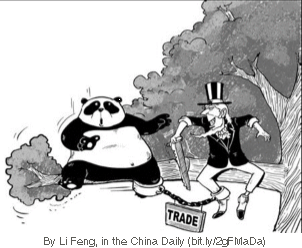
Yet, that’s the word this week. The word preceding it is trade. “Trade War.” President Trump has launched one across the bow, to keep the metaphor in place. But it’s the other part of the war comparison that I’d like to draw on, since I’m not going to stop the use of the term in favor of something else; especially since I don’t have a catchy replacement in mind. The part of the war comparison I’d like to use goes back to the song. In the end, has it really accomplished enough to be worth the price?

Don’t get me wrong, some true wars were worth the price. This type of war though? I don’t see it. I don’t think I’m saying anything controversial by saying this is not a good war. We can debate things like the tax cut bill as far as whether or not it is a financial positive for most people in the end. If indeed you do believe that the recently passed tax cuts are a positive, why counteract that with the “effective taxation” we will experience in a trade war. If you don’t think the tax cuts are a positive, well this only makes the situation worse on a family spending power basis.

We’re not playing with amateurs. There is little doubt that some countries have created an unfair advantage for themselves in trade balance. But there are many countries that have sought, as we previously have, to create tariff free trade, or very close to it. And why would we want to fight with our international friends? That may be something we do amongst our own personal friends, but those fights rarely last very long and the stakes are usually not much larger than where should we go to get a drink and laugh at ourselves?

This is bigger. Blood will not be shed. And for that we’re always thankful. But lives will be affected. Don’t think by not paying attention, not understanding, or even going “La la la, I can’t hear you!” that you can escape the impact. These tariffs aren’t things other countries pay while saying it’s no big deal. This is akin to a real war in that each move on any side will bring escalation from the other. Until no one wins. This makes our goods more expensive. Maybe not homegrown goods. But other goods, from other places. This will have an effect on the prices of more things than it won’t.

So who gains? Industries that more than just trade to blame for their woes. This is the age of technology. Has been for a while now. And every advance in technology brings with it the loss of jobs and industries. I’ve previously described the end of my own industry. Commodity floor trading. The pits are gone. Machines execute the trades now. And while some on the floor looked for any sort of intervention to save jobs, even divine intervention was sought by a few), most realized that this was one of those times when technology advances were a two sided sword. That’s just how it works.

China, the primary target of these tariffs owns more US debt than anyone. To go back to the analogies of little kids that just keep popping into my head, I’m trying to think of a time when I was successful at still collecting my allowance immediately after picking a fight with my dad as a kid. Can’t think on one. Probably because it never happened. But those fights ended quickly. I was soon back to collecting regularly. It wasn’t the best strategy however. And I learned that quickly. How can we not know that this is bad strategy with that kind of monetary impact at stake? Actually a very bad strategy.

The part possibly most difficult to reconcile is that we’re not even excluding “friendly” trade partners from the tariffs at this point. It’s just an all-around “I’m taking my ball and going home.” We’ve spent decades working toward free trade with many allies. I’ve rarely heard anyone who sees a reason to fight with Canada over anything! And yet? We’ve decided to extend this to them as well.

Europe? Haven’t we been doing enough lately to piss them off? Do we really need to do this? These are our strongest allies. And a trade war with them weakens us globally. In that real war kind of way. There’s not a whole lot that we need to retaliate against. But let’s do it anyway. Just like Canada. And Mexico. Why not? Scorched earth. What could go wrong?

Too many things, unfortunately. The rise in jobs in dying industries will probably be temporary. The loss of jobs elsewhere is often harder to reverse. Our farmers get subsidies many would like to see end. They get a good portion of the rest of their income from exports. And much of those to China, whom we’re trying to penalize. Call me crazy, I don’t see China just giving in. So let’s do this math. The farmers will sell less. They will go into their own recession. And what will have to happen? Oh, I don’t know; perhaps more and larger subsidies? Well that didn’t work…

And what are the chances this could really go south and throw off our economy’s long awaited growth spurt after a decade of low rates and little expansion? The chances are not trivial. That doesn’t sound like winning a war, or even having a chance of “Victory.” Heck, it doesn’t even sound like winning a video game. In fact, it sounds a lot like losing. So not only are we starting a war that no one can win, we’re starting one we can easily suffer the most from.

“Say it again…Absolutely Nothing!

There’s A Freight Train Coming Down The Tracks

There are some expressions that at times sum things up so simply. In trading, one of the expressions for not getting in the way of a quickly falling market is “Don’t try to catch a falling knife.” You’ll get hurt. But another one we often used when you saw huge orders come in, and in fact this one is used in many similar moments in life; “Don’t get in the way of a freight train.”

We say this when something big is coming, both good and bad, and we want to be smart enough not to fight it. The Internet and the World Wide Web were such events. People that decided to fight these technological advancements that were on the way to permeating society everywhere were left behind. My old trading floors all closed. The technology freight train. I was lucky enough to see that the light in the tunnel was the proverbial train headed our way and if you didn’t step back and find another way to earn a living, you were going to get run over. And that’s what happened.

The newest freight train, freshly constructed for your perusal, is the announcement that Amazon, Warren Buffett, and JP Morgan have teamed up to explore ways to jointly offer health insurance to their employees outside of the established benefit providers. Obviously I’m not the only one that sees this as a freight train heading our way.

Aetna

Healthcare related stocks all took a hit on the announcement. Aetna opened almost 4% lower that day. And while it did close higher than that, it didn’t come close to recovering, or filling the “gap” created on the open. The action among healthcare stocks led the broad market lower as a whole (Yes, there actually are days that we close lower…go figure). As I touched on in the beginning of this entry, not all freight trains are bad. While we don’t necessarily like the fact that so many people (looked at a teenager lately?) have their faces constantly buried in their phones, few would argue that the internet has led to fantastic advances and control shifts within our daily lives.

So this can easily be one of those good freight trains. It’s kind of difficult to argue. The system is broken. It was broken before the Affordable Care Act (Obamacare) passed, and it’s still broken. Better? Worse? Tough to truly say. There are benefits and costs. Heavy costs in the form of premiums. And most of us are aware of the gap between our state of health insurance nationally and many other countries that have figured out ways to make it work. I’m not advocating any specific system. I am along with most others, advocating some new system, and this could be the beginning.

We’re now looking at 3 large firms seizing control over what has been uncontrollable. And uncontrollable like a bad freight train. The old model, as it were…  So what happens from here? None of us know for sure. Let’s think about what we do know. This is big news. You don’t need me to tell you that, just look at the stocks of companies that will be impacted by a new player. Granted, these three firms don’t represent a gorilla the size of any of the health care providers currently charging us untenable fees for something we all need, but if I’m not mistaken, Amazon was not seen as a company to kill an industry when it started. And now? Been in a Waldenbooks lately? Possibly a Barnes & Noble, but even that is probably stretching it.

Another cliché out there (regular readers know I’m a fan of clichés as they’ve generally been proven over the years to have legitimacy or they wouldn’t have stuck around), is that “If you want something done right, do it yourself.” It seems that’s exactly what’s going on here. Is there a guarantee that they do this right? Of course not. There are no guarantees, death and taxes aside. But examine the players. JP Morgan didn’t go down in the great recession because they have found a formula of making money with less risk than what took the others down. One of the most respected firms in the securities industry.

Warren Buffett. The Oracle of Omaha. Quite a nickname. Nicknames like that don’t come easy. It’s earned over time. Warren Buffett has earned it. He’s been better and more consistent than any money manager most of us can think of. Rallies, crashes, he’s seen it all and come out the other side. His record for the long term will always be a standard. So we’re talking someone who is smart, but beyond that has the insight and patience that have led to the growth of countless companies through the years. Not a person to bet against.

Another person I don’t bet against? Jeff Bezos. The man had a vision. Few of us saw it. But it seems to have worked out just fine for the richest man in the world. And he thinks this is the quickest and/or best way to tackle this. I’m pretty good with that. I still can’t wait to see the real results, but as far as the track record is concerned, the less you believe he can pull this off, well nothing personal, but the more that would probably drive him to be right. That is if he cared about any of our opinions. There are a handful of people that see things differently than the rest of us. Richard Branson. Elon Musk. Jeff Bezos. That’s a pretty successful list, so I’m going to say I think Bezos figures this one out…assuming he hasn’t already.

JP Morgan. Not Bear Stearns. Not Citigroup. Not Lehman Brothers. These folks do it right. They make money when the rest of us are making money, and generally make money if we aren’t. They don’t get written up for scandals…outside of Jamie Dimon’s shading of Bitcoin when we all think he was probably buying at the same time. That’s all we’ve got on them? Obviously another horse worth betting on.

When we put it all together, it seems a train headed in the right direction. Will they have everything right from the get go? Probably not. Will they figure it out? Probably so. Should we all be keeping an eye on this group effort to see if it creates a map for the rest of us down the road? On that one, I have little doubt. Stay tuned…I know I will.

What Just Happened?

SPX 2017

A year ago I wrote about a “reset.” The idea that the New Year was the time to move forward with trading and investing, since the previous year had ended and you had closed the book on your P&L for the year. As we assessed our successes and failures and moved on from those, we should simply do the same with our profits and losses. I do realize this isn’t always easy, but hopefully people found some sense of moving on at the turn of the year and entered 2017 with a clear head, open to what the markets might hold. And a clear head was definitely needed. It is pretty much every year for one reason or another, but it’s always fun to explore that year’s reason.

To me, one of the largest surprises in the markets this year (aside from crypto-currencies, of course) was the ability of the S&P 500 to march forward, month after month, with barely a stumble. While there was not a point at which I came out and said “This is the top,” many others did. This doesn’t make me any smarter, I just didn’t get any “it’s over” signals and I can only surmise that others did. It also doesn’t make my work any better than theirs over time, necessarily. What it does show is that we use different measures and techniques.

I have always made it my practice to try not to pick tops or bottoms. I wait for a market to show a weakness on my charts that communicate to me that the overall trend in one direction is indeed reversing, or at least no longer continuing. The broad equity market never really showed that. The fact that it had some periods of going down in its march upward is of course unavoidable. But the degree of these sell-offs and the length of time they lasted, or didn’t as the case may be, didn’t tell me that it was time to change my overall thinking.

Don’t get me wrong. I kept looking for that reason. I’ve been as amazed as most at the strength, resilience, and longevity of this Bull Run. But that doesn’t mean that I’m going to let that get in the way of analysis, and conclusions that are based on that analysis. I could have easily been wrong. My indicators and techniques might have shown no sign of the crack until it was too late. And a great deal of others would have been right. Though ‘right’ is generally a relative term. If you called for the end of the bull market in February and it ended in November, would you have been right? No, but you might have claimed bragging rights anyway.

None of us are right all the time. No matter the technique, no matter the belief in what is important in the big picture, the best analysts have made wrong calls. And the best of those will quickly tell you about them. Oftentimes, it’s a case of them saying that something had never happened before. I’ve said that plenty. Kind of the point. Remember, nothing has happened before…until it happens. And then it has. And no matter your technique, you may account for all of history but you can never account for all of the future.

So what’s the point? Well, it’s pretty simple. It’s about the odds. I’ve often told people that I think a good bookie would be a great trader. They get the numbers. And they’re disciplined (that’s why I said a good bookie). Their business, and that of a trader, investor or portfolio manager is simply to maximize the odds as best they can. Like a casino, but better. A casino knows that an experienced gambler at a craps table can almost get even odds by playing the table right. Almost. I watched my grandfather do it. And that’s ok. As long as the odds are in the house’s favor, they will still win in the long run.

Flipping coins. We all know this one. Flip it enough, it’s 50% heads and 50% tails. But you may go broke if you’re betting on it when it comes up 10 tails in a row. So understanding the odds, and then making your decisions is the only way to proceed. The odds of the S&P having the run it did this year are pretty slim in the overall picture. History says so. We all thought so. But it went up all year anyway.

The thing we need to remember about all those professionals (and amateurs) that were wrong this year is that their decisions, or at least opinions, were based on the odds of the index continuing higher based on their analysis. People called for the end with varying degrees of conviction, but no one guaranteed it. At least no one you should spend time listening to. That’s the key to longevity doing this. No one has a foolproof technique. No one has seen it all. We’ve gone through discussing six sigma moves happening with regularity, bubbles that are actually more prevalent than we want to believe, and all of the amazing things that can catch us off guard.

It’s a lot like the old saying, “When you least expect it, expect it.” If something’s never happened before, be on the lookout for it happening this time. Use your best techniques to maximize the odds in your favor. And always be on the lookout for 10 tails in a row. Because few of us saw this coming in 2017. For varying reasons, most at some point looked for at least a larger correction than we got. Why? Because we’d never really seen anything like this before. Now we have. But here comes 2018. And its own surprises. To quote The Hunger Games, a movie I took my daughter to when she was younger, “May the Odds Be Ever In Your Favor.” If that doesn’t work, “May the Force Be With You.” And as a last resort, flip the coin again. If your analysis is at all decent, it really will come up heads soon.

Wishing all a Healthy, Happy, and Prosperous New Year!

POP!!…or pop?


While it is no doubt abundantly clear that I am pro-bitcoin and pro-blockchain in general, I’ve tried not to write entirely about those things when writing this blog. As most of my career was spent trading, advising, and charting markets in general long before those things existed, I do have other material to draw on. However, these are the things that seem to be the first topic of many conversations, so I think that writing about the possibility of a new financial ‘bubble’ is appropriate, though as usual I hope to provide a somewhat different perspective…or at least get you thinking.

No matter what you read about bitcoin these days, there is mention of a bubble. The reading, or the conversation for that matter, may be “Yes, it’s a bubble,” or “No, it’s not even close to where it’s going.” Either way, the bubble idea enters the conversation. I’ll start by saying that at some point I do believe there will be a ‘monumental’ collapse in price. But I won’t say when or at what price point. I’m a trend follower. I let the market tell me it’s over…and always a bit after it ended. I’m ok with that. As long as I’m not the last one out, or even better, have time to throw on a short position once convinced the rally is over.

The key word in that statement was ‘monumental.’ And what defines monumental? Just last week we had a price decline of $3,000 in one day. This was 30% of the value. Ok, maybe not monumental, but it was in one day so pretty big. There was of course the time when…And that other time when…Oh, and remember…etc., etc. The point is that this is what bitcoin’s history looks like. Large up moves, sharp “corrections,” and the next large, drastic up move. And every one of those rallies has heard the bubble cries, and as soon as it began coming off, the yells of “I told you this would happen!” Then it doesn’t happen. Bitcoin rallies again to new highs…And again…And yes, again.

Bitcoin 5 year

Of course, the bitcoin bulls and evangelists, the HODL (Hold On for Dear Life) crowd, all say it can’t be a bubble. It’s more important than tulips. I heard that during the NASDAQ bubble. The housing bubble. We can certainly begin to use that ‘bubble’ term here if we believe that at some point bitcoin will rise to a price of “over-valued,” whatever that really means… since value is what people pay, monetarily or otherwise, for something at a particular moment in time. Then of course come crashing down wiping out all but the lucky few. But we don’t know when that is. And we don’t know what the adjustment in its price will be. Probably not to zero. People still pay for tulips, just not what they once did.

Is it ‘different’ this time? I heard something last week from a friend, and unfortunately don’t remember where he said he first heard it. I’d like to give credit. It really stopped me in my tracks and I realized how interesting the statement was (this is the ‘different perspective’ part). He said that the thing that is undeniably different about this occurrence (not calling it a bubble) and previous financial bubbles, e.g. NASDAQ and housing, is that other bubbles have started on Wall Street and when these investments made their way to the average person, or your friendly cab driver was day trading stocks, it was the beginning of the end. This time, it’s the cab driver who’s the new millionaire while the Wall Street hedge funds and traders are hoping to play catch up via new exchange traded futures, and the big banks aren’t sure what to do at all!

So it is different. It began differently and it seems to be surviving differently. And so the most monumental thing going on in this market right now is the game of catch up being played by the money professionals. And that’s just bitcoin. Bitcoin Cash and Bitcoin Gold, to round out that family. Ethereum, Monero, Litecoin, Ripple, Dash. Just a few of the crypto-currencies being traded globally and making people millionaires. Students, millennials of all shapes and sizes, average people, friendly cab drivers. Well, probably ex-“friendly cab drivers”…still friendly, just not cab drivers.

In some situations, it’s easy to label something based on what you’ve seen before. In other cases, it isn’t as easy. What’s difficult to figure out is which one of those it is when you’re living it. This one is no different. I mean, it is very different, but that’s why we don’t know whether the situation is different, or just the names of what’s involved are different. Remember when the internet was new? I do. It was really different. So different, many were in denial. Just another fad. What value is this technology ever going to have to me (there’s that value word again)? And well, today none of us know how we’d live without it. It’s ingrained in our daily existence. How much is that worth if you could price it? Where would its price have started? Would it have been termed a financial bubble at any or all points along the journey to today?

Will this one end differently? Or just become another chapter in The Bubble Book. This I can’t say. What I can say is that when thinking about bitcoin and other crypto-currencies with their value derived from the blockchains behind them, I would suggest thinking more internet than tulip. More disruption than just a prettier color than last year’s version. Then start thinking about whether the asset is over-valued or not. Your own answer may surprise you.