Focus People!

This one’s been tough. I generally look for a pertinent news piece or an event, even as simple as a plane flight, to trigger a topic I’d like to cover that is relevant to the markets or trading and investing. It hasn’t been easy the last couple of weeks to get that spark. I don’t think anyone would be surprised, given that the daily headlines and much of our daily conversations revolve around the first 2 weeks of the Trump presidency, and speculation about what the next 4 years (- 2 weeks) will bring. These discussions seem completely focused around politics and the unfortunate us vs. them our country has become. We’re as separated as we’ve been in a while, but while unfortunate and disappointing on a personal and social level for many, there is more to it than just right vs. left, with a few curveballs thrown in.

I realized that this is the most pertinent topic out there. Not to inject my political opinions or leanings, and certainly not to editorialize on the moves President Trump has made. Honestly, I can debate both sides of many of them to some extent. Thank you high school debate class. But all of what’s going on in the news, as divorced as it may often seem from our business conversations, is affecting us all monetarily on a daily basis. And yes, there are cycles and trends at work as there always are, you just have to want to get away from much of what is headlines, and look at the same things we always do. It’s been more difficult as it’s all just moving a bit faster these days.

You may have missed some of the stories out there related to what we try and do, have an advantage in our decisions, or at least learn more perspectives and seek more information before making decisions. We can start with the US Dollar. From the chart below we see two things very quickly. First, the dollar is almost exactly where it was when the election was held. So we’ve survived the news cycles both pre and post inauguration and effectively gone nowhere. Second, we’re 4% off the high reached the first week of the year. Not a major correction by any means, but it certainly has the chart looking less bullish in the short term.

usd

The major market indices are trading at record highs. Overall perception (which of course is reality) is not that the sky is falling. Respected technicians, Louis Yamada among them, are calling for corrections before we head even higher. At the same time, it is not difficult to find calls for doom and gloom. I won’t argue against a gold rally (I’m a gold bug at heart) but I’m not sure I’m on board with the gloom and doom crash ahead.

We’ve got Snap Inc., parent of Snap Chat, indispensable to my previously mentioned 15 year old daughter market signal, looking forward to a $3 Billion IPO. Crude Oil is near the top of its recent range with many calling for a breakout. I personally think crude is a great mean reverting market by nature once it’s found a range, so I’m not a believer. Doesn’t make me right…Does make a tradeable time in that market.

In the area of cool things that always catch my attention, Lady Gaga had a spectacular show including over 300 synchronized drones. Way cooler than synchronized swimming, and much more important to so much of our corporate future and lives in general. There is no current shortage of articles about self-driving cars. I think that these will be like cell phones, going from gimmick to integral part of our lives in less time than anyone would have imagined. From fascination to need at 100 mph. And when you really want to learn about something that will affect the way we live and work, check out the newest WOW! The Hyperloop. With Elon Musk helping drive this one (pun intended), I’m not going to be the one that doubts the viability, or the timetable for when you and I can use it.

My point is, we are easily distracted, and the media on both sides is doing a great job of grabbing our short attention spans. But success in investing and the markets is driven by getting past the distractions. Most often, the volume isn’t as loud, but the noise always exists. As always though, there are plenty of places to look for opportunity. There are plenty of ways to conduct traditional research and analysis, or if you’re more of a gambler by nature, take a shot. The difficult part is having confidence in the tools that have always worked for you, and understanding that they are more powerful than network news cycles. IPO’s like Snap deserve attention and analysis. Earnings season will always be earnings season. These are constants. They are constants with Republicans or Democrats having the power in our government. They are constants through foreign currency manipulation accusations. And keeping an eye on trade agreements has always been an important thing to consider.

I always go back to my charts, because they help me filter the noise. Others tell me it’s voo-doo, and that’s fine as well. Different techniques breed different opinions. Different opinions breed active and healthy markets. In my last blog, I touched on making a plan. If a type of plan has worked for you previously, then focus on that same type of plan. Understand that it has worked for you before. It may not work every time, but it will work again. Be consistent. Put on some noise cancelling headphones (figuratively). Set them to pick up the information that you find pertinent, and cancel out the rest. There will always be noise. Sometimes quieter, sometimes louder. It’s still noise as it pertains to your investment decisions. Politics unto itself is not noise. It drives our economy. The hard part is figuring out what are the drivers and what is noise…to you. But through it all is opportunity. And that is what we’re after. Now find it, and you will quickly realize that all that our country is going through, on an investment basis, is giving you information to absorb, process, and hopefully profit from. Then sit back and take in the rest of the noise. Act on it socially if that is what drives you, but don’t let it interfere with your investment plans and goals.
“Please take a few moments to locate your nearest exit.”

exit-sign-2

Recently I had the opportunity to take a couple of flights and as always, that was one of the pre-takeoff instructions from the flight attendant. I thought, “Wow, that’s what I tell people when I’m discussing trading rules!” And a new installment was born. For some reason, locating the nearest exit on the plane is something I’ve done since before they began that instruction. In fact, I actually count the rows so if the lights are out, I don’t need to think about it at the most inopportune time. I’m bringing this up because exiting is often the last thing people think about when trading, and when it does come time to exit, you usually wish you were better prepared. This is not only for losses, but for profits as well. Have a plan.

It’s been written in many places that people involved in fantasy sports leagues spend more time on their team draft than they do on their investments. More time on the less important of two disciplines. Sounds ass-backwards to me. Unfortunately, an ass-backwards approach is what I believe drives most trading as well. So much time is spent on the entry, we have little inclination to spend much time or effort on the exit…“I’ll worry about that later.” I personally believe, and teach, that this is the approach that often leads to the wrong outcome. Profits turn into losses, or losses into bigger losses. This is not something I’ve seen in just newbies, but experienced traders as well. It is entirely possible I’m the one that has it backwards, but I’ll explain my reasoning.

As it’s not a profit or loss until the exit, I espouse spending around 20% of your time and effort on entries and 80% on the exit; and plan that exit in advance. Just like on the plane. Now granted, the plane exit thing is an extremely rare event…thankfully. That’s ok. Still have a plan. Because before you trade, just like before takeoff, your thought process is much more rational than when you have “skin in the game.” Getting out of losers is painful, we all hate taking losses. Getting out of winners is never easy. We don’t want to get out too early and watch it go further, we don’t want to get out too late and look back with 20/20 hindsight wishing we had gotten out sooner.

Planning ahead without our money on the table yet is what I believe leads to consistent results. This isn’t even to say that you need to make money on most of your trades. But if you plan correctly in advance you can still make money overall. I’ve been told, “I want a system that has 70% winners.” This is one approach. But if those losers are consistently 3 times as large as the winners you lose money overall. If you only win 3 out of 10, but the winners are 3x the losers…well you get the math. A lot to think about when you’re in the middle of it all.

e-mini-drawdown-2

The S&P 500 reached a peak in early 2015. Before the end of August, it was down just under 10%. In technical analysis, 10% is a healthy correction. Add to your position, if you’re so inclined. Establish a new long position if you’ve got none on at the moment. But while we were approaching the 9.54% bottom, that’s not what was in the news or on many people’s minds. The attitude was the new bear market is upon us. Why? Because people were long and now losing money or at best, giving back hard earned profits. The last thing being discussed by the majority of news outlets was this is actually very healthy for the market. If you brought up the idea of just a correction, which I did (I have witnesses…or it didn’t happen), people thought you had no idea what you were talking about, or it was wishful thinking. The index declined even further in February 2016 after an intermediate rally, and the bear market talk was even louder. Understand, the accepted definition of a bear market is 20%, not even close! If you get out quickly to lessen your pain and ‘it’ goes up again, you can always get back in, commissions are pennies/share.

If you were long the S&P, or your specific securities were going through a similar correction, it was probably painful. You didn’t get long at zero. So your personal pain level was higher. You were not thinking rationally about your positions at that point. You were very likely driven by emotion. Never a good idea in trading.  And here’s where planning ahead comes in. I’m not condoning any specific approach. You may trade with profit targets. You may trade with trailing profit “stops,” accepting in advance you’ll never get out at the top. You should ALWAYS be trading with “stop-losses” either entered when you get into the position as a good till cancel order, or as a mental stop, as long as you will remember and listen to it at the time. You may average your position and buy more. All of these approaches can and do work. Just like profits on 70% of your trades, 30% of your trades, or somewhere in between can and do work. As long as it’s part of the overall plan.

Remember, when you get on the plane, you have multiple possible outcomes. The most likely is to get off at your intended destination, hopefully near your intended time. If the *#%@ hits the fan, you’ve planned your exit. And if it’s somewhere in between, like they lose your luggage, it never hurts to have a backup plan for that either. No matter what, always have a plan in advance. It leads to more profits. It leads to less pain. And whatever the plan, Stick To It. I promise, you’ll sleep better.

Bulls and Bears and Bitcoin…Oh My!

My original intent was to do a blog entry on the Consumer Electronics Show (CES) as I’m both a nerd and I love electronic gadgets. With so much of the show being dedicated to the Internet of Things (IOT) and drones, I figured I’ll have plenty of opportunities to discuss those things and their impact. Plus…I’m not sure how much we really need to discuss a $1,100 wi-fi showerhead (installation cost not included).

Then my mom started discussing bitcoin with me for the first time in a while, and I decided I’d go there first. I initially got interested in bitcoin about 3 ½ years ago, when a co-worker described it all to me. The trader in me said that’s great, we have something new to trade. I told my colleague I thought bitcoin was a “2 year trade,” but the Blockchain is the key going forward. In other words, I thought bitcoin would be worth pretty close to zero by now. My argument was that some country would replace paper with a Blockchain based electronic currency and that would be when the crash to zero comes.

That was 3 ½ years ago. Bitcoin was trading around $100. Now, around $900 after eclipsing $1,100 last week. Just another trade I was a bit wrong on. Thankfully (?), it wasn’t easy to short them.

bitcoin-5-yr-wkly

5 Year Weekly Bitcoin Price Chart

My mom asked me “Why are bitcoins worth $1,000 each?” I said because that’s what someone will pay for them. Simple enough. Everything is “worth” its current price. If someone is willing to pay “$ X” but not “$ Y” then the asset is worth X. That’s why we have exchanges and markets. So why is bitcoin worth nearly $1,000? Because there are people, the buyers, that think so. And since others are selling them up there, obviously some people think bitcoin is worth no more than that. The sellers.

Sure, it can be used to buy some things. Overstock.com made a splash in 2014 when they agreed to accept bitcoin for purchases.  It receives bitcoin for under 1% of sales. Closer to a small ripple than a splash. Not even news worthy anymore. And yet, it’s currently trading in the $900 range. Primarily, it is taking on a role as one asset to use when in doubt about a currency system. Much of the purchasing is said to come from China. And the Chinese government has a way of crushing these rallies with a sentence or 3 about how disapproving they are. Boom. $1,150 to under $900. Just like that.

While trading gold futures on the COMEX in New York for many years, people asked me why gold was worth anything. Back then, it went from over $550 an ounce when I began trading down to under $300. This was after hitting a high of over $800 a few years earlier. There were those who said it was going to go down much further. After all, it’s just a shiny yellow metal. It’s not iron ore, necessary to build buildings. People wear it to look nice. And that’s much of its use. Yet, here we are today with gold, like bitcoin, in that rarified $1,000 price tag range.

When I was asked the question of why it’s worth whatever the price was at the time, I said because “perception is reality.” There has been a perception for thousands of years that gold is a store of value. When confidence in currency values wane, or the perception is that the value that of paper will go down, people buy gold. I continued by explaining that it’s awfully difficult, if not impossible, to reverse thousands of years of perception in a just couple of years. Gold wasn’t going to zero.

So that’s the idea. Things are worth what is paid for them at that precise moment in time. Cabbage Patch Dolls caused fights, near riots, and a robust secondary sales market when first introduced for the holiday season in 1983. I believe it was Tickle Me Elmo dolls that were flying around our trading floors for hundreds of dollars in 1996. Retail price? $35.00. Crazy, huh? I’ll bet a lot of those “Don’t unwrap it, this is an investment!” Elmo dolls have a serious layer of dust. Cabbage Patch too. Did your kid ever cry in the last few years because you couldn’t locate a Cabbage Patch Doll? Didn’t think so. But I’m sure they cried over something else, maybe Hatchimals most recently, because demand was so great you couldn’t get them in time for gift giving. Seems puppies aren’t what they used to be.

These are “Spot” markets, which is how bitcoin currently trades for the most part. This could easily change soon with ETF’s and exchange traded futures. So now people will not only buy bitcoins at today’s price, or value, they will be able to bet, I mean invest in future price movements more easily.

And mom keeps asking, “Why?” To that, I don’t have a real good material answer. I just know that something I bought first at about $120 is now either side of $1,000; 20/20 hindsight, “Wish I bought more.” But at the time I saw the long term value in the backbone of bitcoin. The technology.  The Blockchain. And I do believe Blockchain technology will revolutionize record keeping worldwide. Securities, Legal, Real Estate, etc. But I’ll leave that to another day. Can’t write about both parts in one entry, too much to say.

Bitcoin itself? We’ll see. Can’t hold one, like a gold bar or a Cabbage Patch Doll. Most retail establishments don’t see it as money for purchases. But it’s worth around $900. Perception. Bulls vs. Bears. That’s what makes markets great! Even if mom still doesn’t get it.

Happy Milestone

happy-new-year-2

Milestones. They mark our lives, over the long term and the short term. Communions. Bar Mitzvahs. Sweet Sixteen’s. High School Graduation. Driver’s License! We’re big on milestones. They’re important. They helps us keep track of where we’ve been, and to look forward to where we’re going. Two of our big ones come every year. We celebrate our birthday no matter the age. And then there’s the New Year.

It’s a milestone shared by all at the same time. And we mark it accordingly. We have lists. Top 10 lists generally come out now. Lists of those we’ve lost; people we know and will personally miss, and those who have had some effect on our lives. Family, friends, athletes, stars. Movies come out in time to make the Oscar voting for this year. It’s big. Big enough we need Times Square in New York to contain a few hundred thousand revelers at the same time. And it’s not just the United States. This plays out globally every hour, depending on your time zone, in similar but somewhat different ways. Each country has its own celebratory customs, but they all share one common theme. A feeling of looking back and looking forward, all at once.

And this also comes into play in our investments. Did you do well this year with your (or your advisor’s) choices? Was it a tough one that you’re glad to close the book on? That last part is the one literal milestone here; we close our books. We made money or we lost money. But we count it at year end. So does the government. We log our profits and losses as of the end of the year to help determine our tax burden, or refund. So everyone is paying attention.

As a trader in the pit, this milestone came figuratively every day. The market actually closed every day back then, and as such, we tallied our profits or our losses daily. And in order to survive the profession, we considered it a milestone of sorts every day. If you patted yourself on the back into the next day for making money, you probably managed to ruin it to some extent when the market reopened. And if you came in thinking “I’m going to get yesterday’s losses back,” well this too often didn’t end well. And so every day, the best traders found a way to block out yesterday’s results and start fresh. It was a means of survival, and those that did it the best seemed to have more of those good days than those who didn’t.

Not every day in the pit was a good one. Not every day in the pit was a bad one. A mentor taught me, after a good day, go home, have a quiet night and get up fresh tomorrow ready to make money. Not make money again. Just make money. A bad day?  Do something good for yourself, he said. You just lost hundreds or thousands of dollars. Will a nice dinner out really cost that much in comparison? Generally not. But after dinner I felt better, more relaxed. Ready to go back tomorrow. A really bad day might require buying a new television to really feel better, but the idea was the same. Balance. Even keeled and ready to think straight about the mission at hand the next day.

The great part about December 31st is that it really forces you to follow that thinking. Because if you had a good year, it’s over; and the reminder is a tax bill. Now that’s not entirely a bad thing. I come from a family of accountants, and as such was raised to believe that if my tax bill is bigger this year (politics and changing tax rates notwithstanding), I should smile because it means I made more money. And if you lost money, well the government is going to give some of it back in a fashion. But either way, December 31st is book closing day. A milestone.

No matter your results, or your investing style, embrace this opportunity to start fresh. It’s what celebrating the New Year is about. Don’t spend too much time or effort thinking about your 2016 results. That’s not to say ignore what happened. Take stock (pun intended). What made the year successful? What made the year not so successful? What did you do right? What should you have done differently? That is how we get better. But over congratulating ourselves or obsessing over losses can easily become counterproductive. It’s done. Over. Fini.

Most of us don’t have to reset every day. You might reset every month or every quarter if it works better for you. But no matter what, you have to reset at the end of the year. That annual milestone that isn’t your birthday. Sure, that’s an annual milestone, but it’s date is personal. This is the one we all share at the same time. So my brief bit of advice is no matter what, enjoy the New Year celebration. Life has many ups and downs that we can’t easily reset from. Investing isn’t one of them. Embrace the opportunity to start fresh. Move forward with optimism, and don’t treat every profitable or losing day as if it is your overall result. It isn’t. December 31st is. And that’s what’s great about milestones. They’re markers; they mark the end or beginning of something new. So review your year, plan for 2017. And move on ready to increase your tax bill for the right reasons. Because in another year, it’s time for another milestone.

Thanks for reading the last few months. I wish everyone a happy, healthy, and of course, prosperous 2017. Talk to you next year.

Oh, What A Surprise!

Back before I even got hooked on the sitcom Taxi, as revealed in an earlier edition, my nightly routine included watching reruns of the sitcom The Odd Couple. One of the classic episodes involved Felix throwing a surprise party for his roommate Oscar, who wanted nothing to do with it. Felix convinces Oscar to go through the motions for the sake of his friends who would be attending (sorry, no YouTube clip to be found).

So what does this have to do with our securities markets? The Fed raised interest rates this week. You’ve heard? You’ve been hearing for months. It was a fait accompli. The markets have been telling us. The commentators have been telling us. Heck, once the election was over, there wasn’t anyone left Not telling us. And yet, the markets reacted. Bond futures down (translates to rates up), equity futures up. The S&P keeps making new highs. It seems we all pretended we were surprised. And some people probably lost their ‘bets’ in spite of all the signs. Remember, there was a seller for every equity buyer prior to the announcement, and a buyer for every seller of bond futures.

This move, though, has a great deal of long term implications. An analogy I’ve often used, and I’m sure I did not make it up, is that running the Fed is like driving a cruise ship. Speed boats can zig and zag constantly, changing direction on a dime. And if they want, changing it again if the captain changes his/her mind. Much like asking a kid what they want Most for their birthday. A puppy? A new bike? Ah, an iPhone, since the current one is already a generation old.

But cruise ships? They don’t turn so quick. Titanic, anyone?

A cruise ship picks a direction that it can follow. They don’t want to turn. New York to London does not involve many turns. And this is what I think the Fed has done. I won’t say if there will be 2, 3 or 4 raises coming in 2017. What I will say is that I don’t believe after this second action that there are any quick reversals of opinion or policy coming our way. That ship has sailed, so to speak. OK, too many analogies.

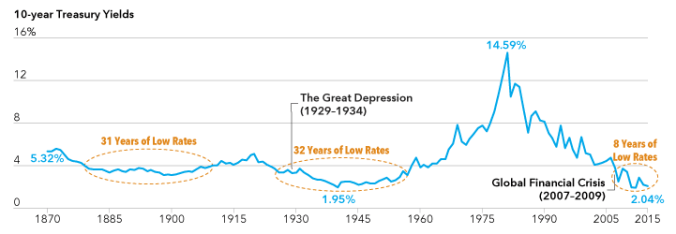
But this is big. Perhaps as big a policy decision for the next few years as our choice for President. There are very few things in our lives, let alone our investment decisions, that are not affected. And if the Fed is indeed more like the Queen Mary than a Scarab, we now have an idea of what the future holds. Not the usual “future” of hours or days we’re now used to paying attention to, but a real future; 5, 10, 20 years or more. Take a look at historical 10 Year interest rates for the last 150 years.

chart-10yr-treasury-yields-2015

None of the annotations are mine. This is not a revelation of any sort on my part. It is, as my blog tries to be, merely observation. The questions it raises are; how is this interpreted, and what are the ‘downstream’ effects? By downstream effects, I mean “Why does it matter to you?” And we can break that down if we want into two categories; life in general and investments specifically.

By looking at the chart, we can see that rates really do have long term cyclical periods. In fact, the above chart says we’re on a path for the next 20 years or more. The first down move in the chart, which takes us to the middle of the first annotation, shows rates moving down from around 1870 through 1900. Rates show a rise from that low point around 1900 to a peak around 1920.  A decline followed until approximately 1940 and then the rise begins; until Paul Volker takes drastic action when Ronald Reagan became President. Since that time, rates have gone down. A few small corrections along the way, but pretty steadily in one direction. Cruise ship.

Every investment decision should now be made with the notion that we are in a rising rates environment. Let me point out that this is a good sign! It signals expansion. It signals economic health. It signals growth. And these are good things. Companies may see this as a reason to gear up for increased demand of their products. Employment slack (yes, I believe there still is some not blatantly shown in monthly numbers) evaporates. Wages go up. These are classic manifestations of an economic expansion. Econ 101, so to speak. And it seems to coincide with President-elect Trump’s positive bias towards business, especially United States business.

And obviously the Fed believes we’re on the right path. It can be argued, and often was by me, that the Fed was not going to raise rates again just before the election. Incumbents like positive stock markets going into an election. It helps the argument that the administration has done well economically speaking, so let’s keep the momentum going. Manipulation is such an ugly word, so I won’t use it. But people have historically voted in a way that they believe will most benefit them financially. We talk and even yell about social injustice and over-reaching government in our private lives, but in the end, we vote for the almighty dollar and our own pocketbooks. So the Fed wasn’t going to raise before the election. And in the words of Oscar Madison in the Odd Couple, “Oh What A Surprise!” when they did.

As to the effect of this rate increase on families? One raise, quarter point, not a huge deal. A few dollars a month on a car or mortgage, but really not much more than one less dinner out. But! If we know that this is now a long term trend we’ve begun, maybe we buy the car or house sooner. Maybe we take on less debt because we don’t want to pay ever increasing rates on our credit cards. This is the early stage. We have a long road ahead, or so history would indicate. Don’t stop buying. Don’t stop investing. And maybe even start saving, since your savings will actually start making money; another plus. Just make sure that when you do make these decisions, you realize what a big change we have just gone through. I’ve never been on a cruise, but I’ve heard they’re great! Economically speaking, this slow turn hopefully indicates we’ve got some good times ahead. Another Volker will come around one day, but history says today is not that day.

Did You See The Election Results?

No, not ours. We’ve been over that. We are over it. We’ve moved on. To new highs in the equity markets. US Bond markets are acting as if the much anticipated rate rise is coming and we’re on our way to economic glory. Let’s recap; Brexit – Yawn, US Presidential – Snooze. So now what? ITALY! Are we numb to these populist movements at this point? Do they no longer worry us? Or have we digested as much of this as we can and it’s on to holiday shopping, football playoffs, etc.

Italy just had a vote, in the nice and simple YES/NO format. The populist explanation of the vote explained that it was a referendum on whether to effectively expand the power of the Prime Minister at the expense of the regional governments and the citizens, of course. And the resounding defeat of the vote has resulted in the effective defeat of Matteo Renzi as well, who resigned when the results became clear. I’ve spent my career looking for patterns, and this one is one easily spotted on your first day trying. WE, no longer believe in what has worked relatively well for a long time. WE is becoming a pretty big group. And yet, while all these movements seem to believe that their votes will bring on substantive change, I’m not so sure that any of them are or will be getting what they think WE’ve bargained for.

Why not? The turnouts aren’t terrible. The balance of the votes are relatively convincing. And the messages being sent to the incumbents and those that would replace them are very clear. But from watching the markets react, and from watching elections as an interested party for quite a while now, I don’t really think these make much difference in the big (macro?) picture.

We do need to pause for a moment here to bring up the fact that this is Italy. Perspective. Before Donald Trump was the US President-elect, Italy endured Silvio Berlusconi and his scandals. This is not to suggest that the incoming administration will have scandals. In fact, that was far worse than even the ugly Trump accusations. And Italy still stands. They have survived enough to have this vote on their future. So as panicked as the British might have been from Brexit, and as traumatized as many were here at home by Trump’s “surprise” election, the countries survive.

There are more votes coming up in Europe. The future of the European Union seems to be in jeopardy as these votes come up and the populists ride to victory. France’s will come in 2017 with much of the same momentum building. As for momentum, Angela Merkel, once seemingly guaranteed re-election could be losing hers, and in turn Germany’s own elections next year. Each time a country goes through this type of vote, the doomsayers are out. Well, they’re basically always out, at times like this they are just are louder and more visible. But let’s look at what actually happened when we’ve had these recent events.

bp-brexit

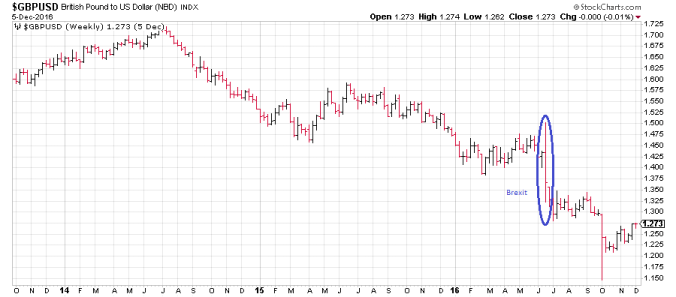
Currently, the British Pound is approximately 12% from where the currency opened vs. the Dollar the week of Brexit vote, when we thought they would stay. Lower? Yes. Disaster?…not so much.

sp-election

I believe we’ve covered the all-time highs in US indexes.

euro-italy

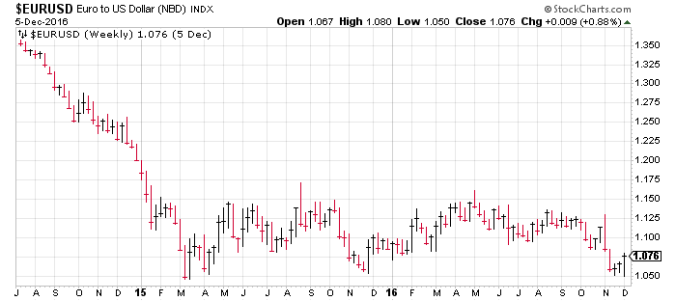
The current (right most) bar is this week in the Euro. While low, its reaction was to sell off and bounce right back. Not a big indicator of an EU breakup

So how do we reconcile the doom saying with the reality? I believe that these charts are merely a representation of crowd beliefs and behaviors. We often over react to a piece of information as evidenced in these pictures by the enormity of the moves immediately following the election and their earliest results.

So as we look at populist voting patterns, maybe we can look at this in a positive. It’s the beginning of people becoming more involved and paying attention. The markets don’t seem to view it as the big negative many on the other side will portray. In fact the market moves seem to indicate that many of those looking for substantially negative reactions were taught that valuable lesson we all learn, many multiple times (point finger at self). Your opinion is just that, the market is always right.

Look at the situation today. The markets are stable. The US is rallying, and many would argue that this can’t hurt the global markets. No matter the rhetoric around no free trade pacts, global trade itself certainly is not going to cease. This is today’s normal. It’s not a new normal. It has come about from the progression of technology and the ability to trade, manufacture and conduct business globally in general. It’s here to stay. This is a genie that doesn’t go back in a bottle. And it looks like the markets know this, accept it, and maybe even like it. Keep calm and keep investing.

When Black Friday Comes…

So Black Friday came as it does every year. Not to be confused with Black Monday. Black is the new black? Anyway, the numbers for Black Friday are good, for online at least. So what does this mean? The economy is good? The sales were simply irresistible? Both? And what does this mean in the bigger picture for investment decision makers? It means a lot, and as usual will lead to some bulls and some bears. Can’t have a healthy market without both.

On a micro level, the earliest returns point to overall gains, with the majority of any increase coming from online sales. We now open doors for Black Friday on Thanksgiving Thursday, and we already start Cyber Monday sales on Black Friday. Serious “holiday” infringement going on. Not infringement to the point of Christmas decoration displays and sales beginning before Halloween, but infringement nonetheless. These early returns let us know that if you have an internet presence, with or without Brick and Mortar to back it up, you think things are good. And this leads us to the impact of this good news.

First and foremost, it means people think things are not getting worse. In fact, looking at the market indices hitting record highs, that news should not be a surprise. Housing sales are strong, unemployment numbers are good to excellent, and our President-elect’s promises of strengthening the middle part of our economy are obviously getting positive reviews…see the part about record highs in the markets. So what could end the party? Well, the party throwers themselves. Those spreading this news. Because we will soon butt up against a law no President can reverse. The “Law of Unintended Consequences.”

No matter your view of the independence of the Federal Reserve, independence is the intent. It is difficult to deny though, that the Fed has been disinclined to raise rates with any real resolve. It is widely accepted that the increases will soon resume, more as a result of the election being over than any new news. But a successful early holiday buying season certainly helps the public argument for the timing. Of course, there were many reasons for piling on the “raise” bandwagon back in mid-2015, and that didn’t pan out so well for those with money riding on the that side of the decision. Personally, I did win a $1.00 bet when it didn’t happen.

If we accept that rates will rise, we need to decide what this will mean, other than a ‘signal’ that we’re back on the upswing, economy wise anyway. I recently got an offer for a credit card with 0% transfer rate for almost 2 years. The television is full of ads for auto rates under 1% for 5 or 6 years. These don’t seem like signs that lenders fear large and/or swift rate increases. Not a ton of analysis there. No fancy software crunching numbers overnight. Simple observation.

So simple, and with so little empirical evidence, that my conclusion must be wrong vs the experts. I can accept that. It was a rather unsophisticated conclusion. When (we’re now accepting it’s when, not if, correct?) rates do rise, what are the implications. What are the Unintended Consequences? We can examine some of those simplistic examples to start. Credit card rates are low. Holiday sales are ‘good.’ Not so good that analysts are claiming to be caught off guard, like they were in the election by unbelievable results (see last blog). The majority of early analysis points to the deep price discounts as a major driver of sales increases. But still, early holiday sales are good. With consumer rates still hovering on the lows, remember.

Auto sales are also strong. The effect of cheap money must be counted as part of that. On the surface it sure sounds like a growing economy with smoother sailing ahead. But let’s take a look at the other side. Much of what is fueling us (oh, forgot cheap oil!) is cheap money. That’s The Fed’s work. Thank you, Federal Reserve. So what happens next month? Next quarter, next year? If thing’s work like they are supposed to, the Fed will continue to lag behind growth a bit and we’ll have a great Trump economic expansion. What does spending look like if rates are high enough for consumers to feel the impact every month?

The primary question that remains unanswered, but has large bets on both sides, is what happens when The Fed does start a path to higher rates. This is where the possibility of unintended consequences comes into the picture. After rates go up, and it is tougher to get a loan, will housing survive? There is currently a tight supply there. This is a market that could easily chase itself, as fear of rising rates leads more people to look at purchasing a home while they can purchase more. That drives the prices higher along with increasing rates, and all of a sudden a decent home is again out of reach.

Purchasing power would go down with increased credit card rates, and we would then learn the true amount of debt “The Jonses” are carrying. This is the part that we always need to explore when discussing micro sounding issues like a rate increase…what’s the macro effect. And is that macro effect actually what we expected or intended? If the economy is indeed in strengthening condition, we will enjoy the ride until we swing too far the other way…maybe not Volker too far, but we will swing too far to some degree. We have had dirt cheap money for a long time. At some point we’ll look back and say money was cheap too long and we let ourselves swing too far. Hopefully, it’s already happened and we’re on our way to continued economic health. That’s what the rallies in all the market indices are signaling…today.

Either way, don’t get completely caught up in one argument. That will be the first step toward letting emotion take over and creating blinders to stop you from seeing the big picture. And lest we forget, that’s the most important picture there is.

Wait… what?

By now you’re aware we had an election last week. I’ll bet you even know who won. What’s left to write? I stayed awake that night watching historical moves in futures markets. I guess when it’s caused by an election it’s an historic event. When it’s caused by less easily explained factors it’s called a crime. The “Flash Crash” was the same dramatic move. Granted it happened faster in 2010, but in the end, just like this week buying came into the market. In fact, as a technical analyst, this week’s move was very bullish on the charts.

Two years ago, I had the opportunity to work with someone new to trading. He was a 26 year old physicist. I was not the smartest one in the room. Yet here I was teaching a “quant” about technical analysis in futures markets. He commented that a six sigma move, or six standard deviations from the mean should only happen, as he put it, “…once, maybe twice, in my entire family lineage. And I’ve seen 5 of them in the last 2 weeks.” I laughed and said “Welcome to the wonderful world of commodity trading.” And isn’t that really the cause of the flash crash? Too many standard deviations, not an evil empire taking down our economic backbone or, in my opinion, not someone breaking rules that existed at the time. Maybe it’s just gravity?

So how then, do we come to some sort of explanation on the market move and the election itself? The polls were obviously wrong. The pundits were wrong. Was the ‘market’ wrong? The market was right. The market is always right. We think the market is wrong when it acts illogically but the price is merely a result of our opinions, logical or not. Usually not. The market is not a living breathing thing. The prices though are decided by living breathing things. And those living breathing things had decided Hillary was going to win and this was deemed good. Then we decided she was going to lose and this was bad, until it was good. So what gives?

If you think this is the spot where I give a great explanation of why the market moved the way it did, it’s the wrong spot. In fact, it’s the wrong blog. I don’t want to write my opinion, and that’s all it would be. Rather, I want to make an observation. The rock band The Who were wrong; we will get fooled again. Why? Because 6 sigma moves just don’t happen, except when they do. And this was the perfect example. Brexit wasn’t going to pass. The surveys told us that. The pundits told us that. Both wrong. Sensing a pattern?

When we had Friday Wraps at Bloomberg, I always asked my younger colleagues to suggest a topic whose impact we could discuss across the market sectors. But one week the pre-meeting banter, and laughter, was around the story that Donald Trump was going to run for President. Topic found. We opened that session by me suggesting everyone stop laughing. Did I think he would win I was asked. No. Did I think he could win was the next question. Again, honestly I didn’t. But I wanted everyone to understand that despite my personal opinion at the time, yes he actually could. This was not a declaration of my preferences but just my years of observation peeking out.

I’ve been surprised before and wrong way more than that. But what no longer surprises me are surprises. Six sigma moves. They happen all the time. Usually they happen when a lot of people are wrong. Or confused. Or both. And then we try to explain them. And how we won’t miss it next time. But we will. We will miss it again and again. It’s human nature. Human emotion is not the logic of math. But human emotion drives our opinions, our opinions dictate our decisions, and our decisions dictate the whether the price goes up or down; math and the accepted frequency of six sigma moves be damned.

So what happens next time? Do we learn from this and have a more ‘correct’ market opinion next time? I think we learn from all of these historic occurrences. But I think that the lesson we’ve learned twice this year, from Brexit and the US election, is that no matter how convinced you may be of an opinion, the market will find a way to remind you of the fact that the most unlikely of events are just that, unlikely. They are not impossible, they just create bigger moves. Hopefully we’ll all remember that the next time we’re “positive” of what can and can’t happen. Stop laughing.

Trick or Tweet

            vote_pumpkin                     ht_trumpclinton_pumpkin03_mcm_hb_161013_12x5_992

Twitter lost $103 million last quarter, and is even laying off workers. In the age of Internet company revenues, this should hardly be news. In the age of Social Media, however, it’s definitely worth examining. Particularly in the case of Twitter, as its influence is much larger and more widespread than merely a bunch of athletes and celebrities sharing their most interesting and deep thoughts. And on top of the loss, Twitter quickly followed with an announcement that it will be shutting down Vine, the home of the 6 second video.

Now it’s true that as one gets older, life seems to go by quicker. This is easy math. At 10 years old, a year is 10% of a lifespan, at 50 years old, that year only makes up 2%. Ask a parent…goes by quick. But Twitter? Vine? Here to stay. Oh, that’s what we said about MySpace, if I remember correctly. In fact, we seem to say that about a lot of things these days. Life goes by quick. Even the election will be over soon.

The shutting of Vine is probably less of an impactful event than Twitter losing money and growth rate. But it does go hand in hand with the point I’m getting to. That is, the things we quickly think of as constants are less and less constant or long lived. No wonder we can’t “invest” for the long term anymore. Short term trading is almost the entire life span of some of the most valuable companies. Recently, the long running magazine show 60 Minutes did a story on social media influencers, with a good amount of focus on Vine. And just like that, it’s gone.

As the father of a 14 year old daughter, even I knew Vine was “old news.”  Yet, I wouldn’t be surprised if many viewers had never even heard of it, though they’ve all heard of Kim Kardashian. Vine was deemed so world changing among social media apps that Twitter purchased it before Vine even launched. And it really was the king of that ‘genre’, short homemade clips that for some reason people cared about. That was 2010. Some reports gave Vine a top effective value of almost $1 Billion dollars at one point. Not bad, except almost as quickly as it rose, the Vine rocket has crashed back to Earth.

Heck, I haven’t even mentioned the true gorilla in the room yet; Facebook. The advantage I do see in Facebook is the number of small or even home businesses reaching customers via the app. A downside? When I look at the age distribution of Facebook users, it seems to me the skew is moving older.

statistic_id187041_facebook-demographics_-distribution-of-us-users-2016-by-age

More grandparents than grandchildren on the site soon? That doesn’t bode well in the social media world.

However, for that same $1 Billion value that Vine reached at its peak, Facebook bought Instagram. Recently, Forbes estimated Instagram’s value at $50 Billion. Nice return. On top of which, it’s a site my 14 year old can’t live without!…until the next one comes along.

So, back to Twitter. While working at Bloomberg, it was impossible to ignore or discount the influence of Twitter on the industry. Social media had finally come of age, as Bloomberg, its competitors, and many other firms looked for ways to filter the immense amount of noise around some actually pertinent tweets. Twitter’s influence on today’s investment community cannot be overestimated, let alone ignored altogether. Stories take on added importance based on retweets, often at the expense of fact. I’m sure again soon we’ll all put our faith in the next new and improved, and then be forced to move on from that one as well.

But this is what we do, and have done as long as the securities industry has been around. We take information, process it, and make decisions based on our conclusions. Previously, the effort was in finding the information. Now the effort, and computing power, is used to actually filter Too Much Information. Just like security prices, there is a large swing of the pendulum in how we ascertain value, probably prior to returning to some sort of mean, or normalcy. The more things change…and all that.

Or is this “The New Normal?” I’m not a big believer in the new normal. I’m a bigger believer in 20:20 hindsight. The world just doesn’t change that much in such short periods. Instead, we just keep searching for the best way to get the best information we can, and before anyone else. Then we look back when we’re wrong and say, “D’oh…It was so obvious.” So the next time there is a new phenomenon, or bandwagon, or whatever else you want to call it, it’s actually just a part of the constant move forward, unfortunately often happening too quick for a glance in the rearview.

As my uncle wisely said almost 15 years ago when my daughter was born, “Don’t blink, you’ll most certainly miss something.”


ETF, On the rocks – with a twist…

There was an ETF recently launched based on whiskey prices. This alone may or may not be deemed as a truly newsworthy event, but with an affinity for Single Malt Scotch Whiskey (Islay region to be specific), it certainly got my attention. The obvious discussions can be about; is the make-up of the ETF broad enough to truly cover an entire industry and is the ETF issuer backed well enough to guarantee both liquidity and long term viability? There are of course many other similar questions that can and should be asked about a great number of ETF’s, particularly the more esoteric ones, like whiskey prices.

I do think ETF’s have a place, so this is not a statement on their validity, but merely a statement on the obscure nature of some of them and their place as financial securities. I believe the long time justification has been that they can give the general investor access to specialized instruments that attempt to track entire industries or specific indices. And in the age of cheap trading they have certainly added to overall liquidity. Heck, one like this is even FUN!

The other instruments that are traded with reasonable liquidity in multiple places are binary options, i.e. you’re right or you’re wrong. These can even be single day or week bets, oops…I mean investments. And in Las Vegas there are plenty of places to wager on other events. What I’m not sure about anymore is really how these lines are drawn. I can ‘wager’ on the future price of Whiskey, but wagering on sporting events is made much less accessible to the general population, legally anyway. I can ‘wager’ on the close of the S&P Index, or even the weather via exchange products, but not how much the unemployment rate will go up or down next month.

Many would argue that sports gambling is regulated the way it is to avoid game fixing. For the most part, this works. Like anything else there are exceptions; the Black Sox, Boston College Basketball, Tim Donaghy (ex-NBA basketball ref), and a handful of other publicized occurrences. But when you read about John Stumpf, the now former CEO of Wells Fargo who resigned due to a policy of opening phantom client accounts to show the company meeting metrics, I would say price fixing and influence is being exercised in the financial markets as well. The value of a CEO’s bonus granted options are tied to stock price. Meeting your target metrics always pleases the fundamental analysts, which in turn should lead to higher stock prices. There is an inherent desire to make the price go up. Just like my inherent desire to see the New York Giants win the Super Bowl, which is only open to legal gambling in Las Vegas, not via an E*TRADE account.

Currently, we have what would probably be the largest betting pool item in history; the US Presidential election in a mere 20 days. I can’t imagine with the polls having spent so much time within the margin of error that people would not have enough interest to wager. There was a website that for a few years did facilitate this. It was called Intrade.com and was billed as a “prediction market.” It was definitely that. In the 2008 election, the predictions were within 1 electoral vote of President Obama’s returns. And I miss that accuracy. Intrade was shut as a result of both government action and financial ‘issues.’

What we currently have are polls to predict. But this is even more imperfect than usual. Polls suffer from many inherent flaws; question bias, sample size, etc., which can all lead to results skewed to the author’s intent, be it intentional or not. In this election, we have access to more information and faster than at any time in history. It should be easier to decide on this than it has ever been. Certainly we’ve got more information at our fingertips than we do on the supply chain of Apple products.

Yet we now have an election where discussion or dare I say debate, let alone declaration of a position on which candidate we support does not seem to be taking place in any public manner.  Taken a drive recently? Walked around your neighborhood? I find the lowest numbers of bumper stickers and lawn signs for Presidential nominees that I have ever seen (unscientific, I know).

It’s easy to understand this phenomenon, this election is between the two least liked candidates in history. And this is why I miss Intrade. If I want to bet on the direction of whiskey, I definitely want to bet on this, but in a financial sense, not in Las Vegas. Both whiskey and the election are important to me (depending on election outcome, whiskey may move up), but the excitement of the election is more akin to weekly fantasy football from FanDuel or DraftKings than it is to a season long fantasy league where you know after week 9 you have no chance. So we’re back to the line in the sand. Back to the problem of ‘influence’ in sports betting.

For me, there is less chance of a truly rigged election than there is of a rigged football game, or a rigged company balance sheet. There is certainly enough interest for adequate liquidity. There is an easy way to measure being correct (Intrade used a 1 to 100 scale to effectively show percent probability). We have lots of elections and we have many other real time scenarios that people would wager on, fixable or not. Music and film awards (fixable) or number of new generation iPhones sold on release date (less fixable). In fact, the iPhone prediction market would actually open up investing in Apple on a short term basis that could be less expensive and therefore more accessible to the average citizen.

Will we ever really be able to legally make financial security level investments in these short term events? The way things are going, I’m guessing probably. File it under the handling of OTC contracts within Dodd-Frank. When you look at it, there’s not a big difference between an opinion on the price of oil in November and the winner of an election in November. And the similarities of the election and the legal financial markets just continue from there. The election is really an investment, just like a whiskey ETF, but even more important. So we should all invest in those Futures, even if you can’t do it with money.

Or maybe it’s just a tummy ache…

There was a recent University of Cambridge study that was mentioned in the Wall Street Journal and the Financial Times, among other media outlets, regarding the actual success of using “Gut feelings” for trading success over using machines. Of course, an article like this also flew around LinkedIn, at least among the types of people I am primarily linked to. At first I chuckled and then began to ponder…

If you’ve read my About page (if you haven’t now is a good time) you know that I ‘grew up’ in futures trading pits. This was a true bastion of gut trading. While I did also learn technical analysis (charts – oops, I mean “Data Visualization”), much of what all of us did was act on our body’s reaction to what was happening around us. A lot of times “I know it’s going up” was the reason to load up on a position. What’s humorous is that somebody else’s gut was telling them it was going down at the same time. If all those guts where right at the same time we’d never have had a functioning market.

“Our results suggest that signals from the body, the gut feelings of financial lore, contribute to success in the markets,” is how it was phrased in the study.  While the articles I read didn’t seem to mention a direct comparison to machines and algorithmic trading, most of those same articles did mention this implication, that ‘gut feelings’ can outperform those computer models. Having used both approaches in my career, I’m not sure which way to lean on this, but really can’t stop chuckling at the study itself.

One of my favorite college Political Science professors also did work for one of the major polling firms at the time. He taught us how easily any survey can be “rigged” to reflect the pollster’s intended results, and they usually are. This political season has certainly given us the opportunity to hear this refrain. No matter which side you’re on, the reality of this shouldn’t be denied. Not that we should stop surveys and polls, we just need to understand the inherent ‘flaws’ in the results.

And so it is with trading and investing. The Cambridge University article was published on September 19, 2016 and more widely publicized in the 2-3 days following. And yet, at the same time, a column was written on Yahoo Finance titled, “The Old Wall Street Trader Is Dead, Algo’s Now Rule The Day.” Here we’re told that “Big Data” is now what drives trading. The ability to analyze unimaginable amounts of information in equally unimaginably short periods of time has to over-rule gut, intuition, intelligence, etc. So how do we reconcile these two equally valid yet diametrically opposed viewpoints?

As a fan of ‘whatever works,’ I wonder if we really have to. As to the gut feelings, I’ve always actually compared this to the work I’ve done on automated trading models. In trading and investing, Discipline is generally accepted as a necessary trait, perhaps the most important. And the reason for automating trading, be it mean reversion, the generally accepted ‘aglo’ style, or automated trend following, where I spent most of my own programming and testing, or both, is to enforce the discipline of repeatable action. This was my best method of taking my emotion or gut OUT of my trading. Huh? One thing I learned about my own gut was that the feeling there was more often indigestion than a correct hunch. I don’t, however, completely discount the gut feelings of the “broad” study sample of 18. Really? All those articles for a sample of 18? Given the sheer number of ‘gut’ traders out there, I’d call that a rather limited group from which to draw such an impactful conclusion…maybe we’ll cover that part of statistics another time.

I chalk up the successful gut trading to the unconscious recognition of previously successfully acted on conditions. In other words the situation, or setup, has some resemblance to a previously successful trade or investment. And it is that recognition that fuels the body reaction. For myself, I needed to put it all in code. But these guys (it was 18 males in the study) were able to judge the difference between being right and feeling ill. And isn’t that what the use of charts is all about? It’s a way to see the effects of people’s decisions based on what they felt in their guts and brains. And then I took those charts and programmed the repeatable pictures I was looking for. So here we have, what in essence is the combining of the case of relying on your gut, and the use of programming machines to all accomplish the same goal, profit.

No matter what side of this your opinion falls on, I prefer to just lean on the idea of “Whatever Works.” I always return to my charts because I find it the easiest way to interpret what You are doing and then acting in response to that. The beauty of this industry and the reason it thrives is due to all those differing ways of processing the available information. Research, programming or indigestion, they all work and they all fail. Pick the solution that fits your strengths, and keep the Discipline. The rest is noise.

Samsung, Lithium and Yellow Lights

Reverend Jim: “What does a yellow light mean?”
Bobby: “Slow Down”
Reverend Jim “OK…Whaaaat dooooes aaaa yeeeeelllllooooowwww liiiiiight meeeean?”
Bobby: “SLOW DOWN!”
Reverend Jim “OK…Whaaaaaaaaaaaaaat Doooooooooooooooeeeeees aaaaaaa…”

Well, you get the idea. This was one of my favorite scenes from the old US sitcom, Taxi. I think we’ve all forgotten about the yellow light and the idea of slow down. This episode came to mind while reading about the Samsung Galaxy Note recall, soon followed by an article on Lithium prices. I think that phone batteries catching fire can easily be looked at as the state of society and the way recent market cycles seem to move, like everything else, in the blink of an eye.

The Samsung recall; burning batteries. The Motorola StarTAC flip phone (first flip phone!) was released in January 1996. Its successor, the Motorola RAZR, was not released until Q3 2004. Other than a slight weight reduction and the introduction of colors and other small style enhancements/options, the original StarTAC remained largely unchanged during its entire life cycle. This was also the first phone, I believe, that had a lithium ion battery available for extended life.

Here we are 20 years hence. And look at Lithium now…

lithium-production3

lithium-price2

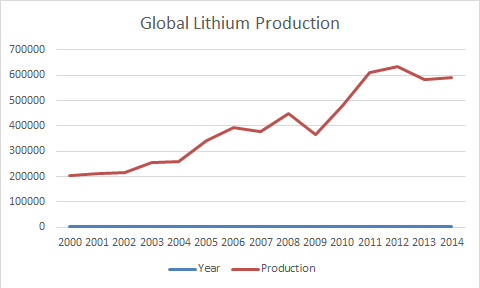
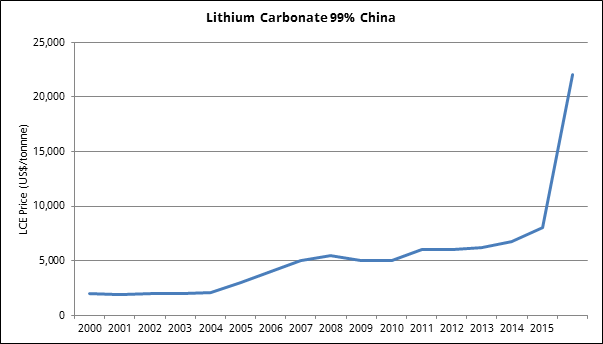
A couple of things strike me about these charts; it seems production and prices both rallied rather smoothly until 2014. Look at prices last year! Best known as a “Parabolic” move. Production doesn’t keep up any longer…We’ve all got cellphones in our pockets. These have more processing power than an Apollo moon mission, and better screens than those awesome Sony Trinitron’s of the same period. In our pockets! And we all complain about battery life.

We can easily add to the demand equation when we start taking into account electric cars. Growth of electric cars, I think we can agree, stands to expand probably exponentially. Currently, the electric cars available are also using Lithium sourced batteries. And cars are only the beginning of the impending demand thanks to Elon Musk. His plans for home batteries to store solar generated power are the tip of yet another demand iceberg. Tesla is building batteries for Southern California Edison to store 80 megawatt hours of electricity, enough to power more than 2,500 households for a day. The question of how much faster we can extract lithium, and how much exists now come into play. I’m not sure what an uber-parabolic move looks like, but I’m guessing with no relief, we would find out from the lithium price chart sooner than later. In fact there is no shortage of articles, columns, and blogs talking of the next price spike.

This is where I think we’ve lost all sense of Yellow Lights. We move as fast as we can from zero to one hundred, but don’t take stock (pun intended) of the long term implications. From Samsung possibly moving too fast to jam in as much power, and support for that power, into a small fully sealed, barely cooled pocket computer, to California’s ambitious plan to install 1.3 gigawatts of storage by 2020, we don’t slow down to figure out the downside…and every upside has a downside. Pocket fires, airplane battery fires…there are no fire issues in California, right?

Now to the markets, and the many directions this simple Lithium discussion takes us. Short term (is there really anything else? – Read first post…) we can examine Lithium mining, lithium supplies and supply chain, battery manufacturers (Panasonic supplies Tesla). We can look at utilities, which of course comprise one of the largest sectors of fixed income securities in the US. We’ll call that the medium term. As to the long term, what’s next? When the StarTAC came out, Lithium ion batteries were the newest rage. Lithium was cheap, too. So what’s the next power storage discovery?

There are alternatives already, they’re just not “there” yet. But in this zero to 100 world of ours, I promise no matter how long you think the next generation of storage will take, it will be here sooner…and that will be our new definition of “long term,” and that parabolic chart, well we all know about what goes up and that equal and opposite reaction thing.

In the meantime, there are plenty of ways to bet for and against the current and future technologies; commodities, private equity startups, fixed income, traditional equities. Choose your arena, but whichever one it is, don’t blink, there are no yellow lights.

Friday Wrap’s

In a previous role, I hosted a ‘Wrap’ session. These brief 15 minute roundtables allowed us to take a current event and discuss the implications across the entire investment industry. Sometimes they were esoteric or seemingly mundane, one discussion started around an impending snowstorm and the chances of working from home, yet we found market impact.  Sometimes they were top of the news, such as when Brexit was supposed to immediately and dramatically influence our lives…not so much. No matter the initial topic, there always seemed to be a way to show impact across many, if not all parts of the securities industry. Much of this industry is treated as separate silos, yet it is important to understand what other people are thinking as they make their decisions about trading and investing.

Having spent almost 14 years in commodity futures trading pits, knowing when someone might be bluffing was a large part of the advantage of having a membership. Take poker for instance, where reading the face of your ‘opponent’ is more important than the cards you yourself hold, or so I’m told…Unfortunately, with trading all being conducted by electronic means these days, reading your opponent has become much more difficult. Additionally, the availability of information in milliseconds, though not always accurate, has also put a new spin on the game. It’s often tougher to figure out your own opinion much less trying to guess someone else’s.

It’s truly a reality show out there. Major and minor events often have equal immediate impact as well as being forgotten quickly, as we move on to the next ‘episode.’ The Kardashian society we live in today demands a short attention span. Dwell too long on one topic and you’ll miss something; everyone else has already moved on to the next shiny thing. The anticipation leading up to Scottish secession was palatable. Yet, within the blink of an eye, we were on to Brexit. As a bonus, the Democrats and Republicans provide non-stop soundbites to mull over, in something maybe more akin to a reality show than the campaigns of our next president and the runner up. Retirement fund meet pop culture.

Okay…So far, I’ve covered playing poker, pop culture, and a bit of world politics, but nothing about investing, or trading (Jesse Livermore pointed out the difference between the two) as we all seem to now do since it provides much more immediate gratification. But that’s what this blog is actually about. The 10% correction is no longer looked at as a healthy break, but rather a mini-series beginning as the end of the world and ending with a ‘whew’ moment, looking for someone else to blame of course; then we’ll vote them off the island.

The securities industry itself has often suffered from a habit of making silos. A fixed income manager was not much use to an equities guy. The commodity traders, well they were a small group, so what influence could they really have. The technical analysts, the guys with those weird charts, well that was all voodoo anyway. Now everyone wants to know what everyone else thinks; no, everyone needs to know what others think. No successful foreign exchange trader is ignorant of commodity prices. No fixed income trader is quietly plying his trade in a cozy office on another floor. They are all glued to CNBC, Fox Business or Bloomberg TV awaiting Janet Yellen’s next words. At times, it feels like they’ve all become my 14 year old daughter gathering with her friends for the season finale of Pretty Little Liars.

This, finally, brings me to the essence of creating this blog. How does it all tie together? Is the growth of the first flower in space as important as the Greece bailout (any of the bailouts…)? Well, not nearly as many people are talking about the Greek bailouts as earth shattering events at this point. Short term, intermediate or long term, I’m no longer constantly reading and hearing about the profound impact the bailouts will  have on my life and portfolio. Of course, I’m not hearing much about that Zinnia in space either, but in the long term that probably has a larger impact on our society.

Think about it for a moment. Beyond giving your wife anniversary roses while colonizing Mars, this development has long range implications for the drug industry, the cosmetics industry, the food industry, etc. Is there one on that list that you did not make the connection to? While not an immediate life changing discovery, if I’m following one of those industries, young, patient, looking forward to finding an edge that will help me stand out, I’m looking for offbeat stories like this. Why? The number of pharma companies, cosmetic companies and food companies that utilize flowers is a large universe. Clothing companies? Sure, add them to the mix. All of these industries will be affected by flowers in space. This will then extend, of course, to commodities; cotton prices will be affected if clothing materials can be grown in space…

Admittedly, this will not happen tomorrow. And, sadly, most investors, save for the few Warren Buffett’s among us, will not see past today’s account balance, this month’s statement, or at most, the last quarter or two. So we miss the story. Or worse, ignore it completely as unimportant. Should it be ignored? Well ponder this: 2-3 years ago, few believed Elon Musk could change the auto industry, the battery industry, the entire power supply industry. From coal producers to those that maintain the grids, his influence is being analyzed and felt globally, and in a much shorter period than most would have predicted.

It’s this ‘big picture’ (macro I believe is the current vogue term) that most have lost sight of. Is the 10% a healthy correction? Certainly doesn’t feel that way at the moment it’s happening. Has my money manager kept up over the last 5 years? Doubtful; because if he hasn’t kept up with the last 3 months he may be looking for a new job and you a new advisor. Goes against all that is preached, yet this is our reality. Why? Because perception is reality; and perception rarely sees more than a week ahead these days.

All this, and I didn’t even touch on the election. I hope you’ll come back to read about my perspectives on that, as well as the hidden treasures in the news. It’s not about my opinion, it’s about how you arrive at yours. THAT’S A WRAP.