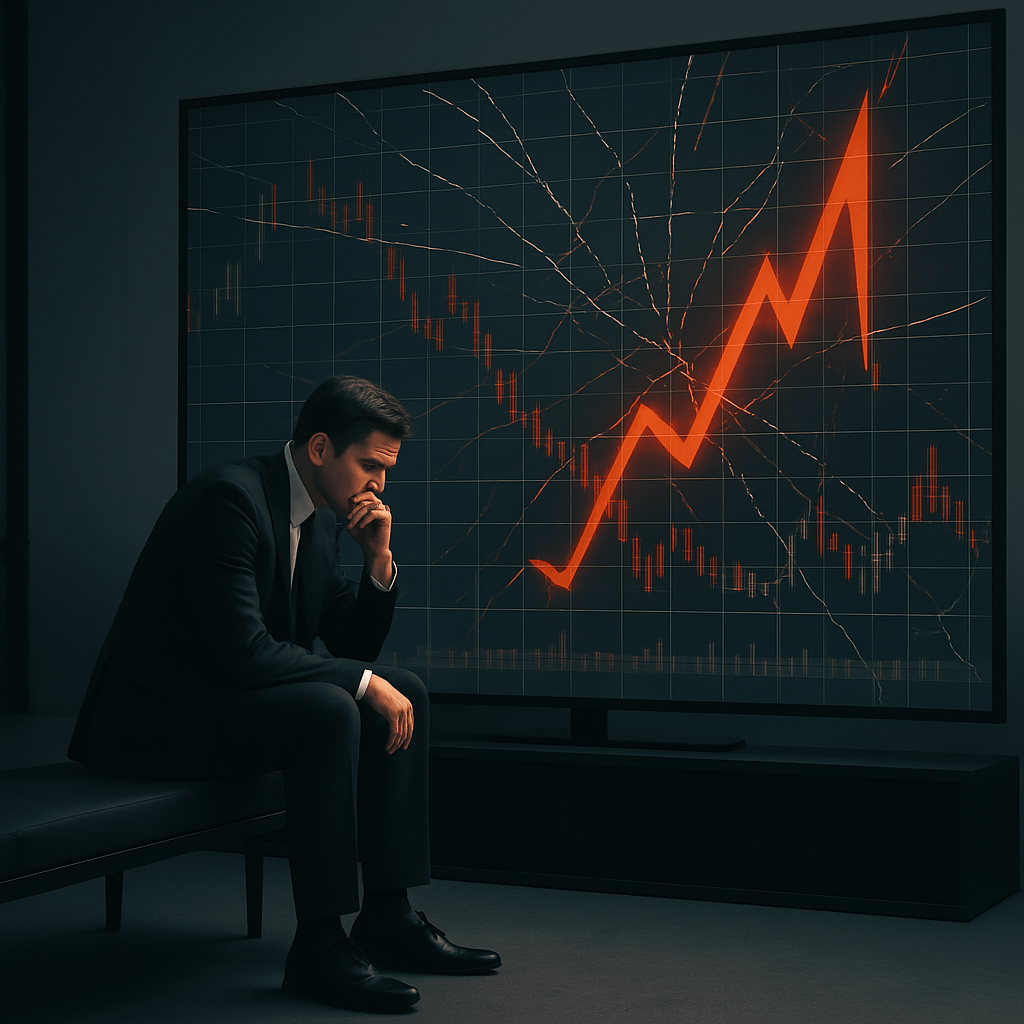
Step Away From The TV

…Or the computer screen, or the cell phone. Unless it’s to put on some meaningless background noise. That’s what we did in the prop trading shop. We rarely had CNBC or Bloomberg TV on. Generally, we tuned into sports, Netflix, that type of thing. Something you could ignore. Business channels? Maybe if there were interesting things going on. This would probably have been one of those times.

Traders have often latched onto the saying attributed to Confucius, ‘May you live in interesting times.’ Blessing and a curse. To a market maker like I was, volatility was something we looked forward to. But as you’ve probably gathered from previous blogs, we were a different breed. Like people that love the biggest roller coaster you can find (me), vs sane people. And it’s not just the old pit traders from the floor. The early days of screen trading had tons of opportunity for that style of trading. Now? It’s awfully tough for a person to compete with the speed of machines. It’s really why I preach to you, my readers, to not gauge your success on a daily basis. Look at trading, or investing is an even better term, as a long-term game proposition. That’s something that has yet to go out of style.

Meanwhile, back to the television. The thing about our prop trading office was that we didn’t trade off of the host’s discussions that tried to explain sudden news or even, for the most part, off of the news headline itself. We would switch to CNBC, however, when something new did come out (flashing on our screen), so you would at least have a basic understanding of why your trades, win or lose, went the way they did. You’d hear someone say something and stop to listen briefly. It’s a bit of a talent to filter noise while still being able to grab the occasional important tidbit. Or maybe it was ADHD. But either way, the stops were in. Now move on to the next trade.

Other than the very, very small community of insane traders, the thing that virtually everyone that interacts with markets does not want is extreme volatility. Pick a direction. Progress, up or down, over time. I’ve been asking friends/colleagues in the finance world how their necks are. It’s really a type of mental whiplash. The constant knee jerk back and forth will destroy any trading strategy. In crypto, people look at how many positions, or how much nominal capital losses were stopped out, or ‘liquidated.’ I don’t consider watching others lose money a sport. I will say that crypto has not been shielded from what’s going on in traditional markets right now either.

But it’s exactly those traditional markets moves that are leading to stories you’re reading. I’m not passing judgement on tariffs or any other current market moving news. I am passing judgement on surprises. They’re bad. And when they rock the bond market, they can be really bad. Why. (Yes, I know there should usually be a ? to end that sentence; this time it’s a statement)

Because bonds are different. Interest rates are different. I’ve written a blog on the slow movement of interest rates. I followed up by admitting that, in that instance, I was wrong. The Fed moved one way then shortly later moved the other. When thinking about interest rates, it’s easy to understand why these are generally long term ‘trending’ markets. Because long term decisions are made based on the expectations of interest rates. Should I buy a house now? Will lower mortgage rates a year from now position me to buy a larger one? Or in my first choice of neighborhood? Or, will I be upset if I don’t pay over asking for this house now because next year interest rates may not allow me to buy it at all. Everyday decisions for everyday people.

Businesses, from small to large corporations, also can end up successful or not based on interest rates. To put it in business or economic terms, what is my cost of money. If I borrow to buy some new equipment for my neighborhood store, or build a new factory for my large industrial corporation, how much does it cost me each month? Business decisions for business people. Same thoughts, just different scale.

So that’s it. That’s why what’s going on around us is, to me, more f’d messed up than usual. Because it’s surprise after surprise after surprise. Usually when these types of things happen, it’s one surprise. Granted, one BIG surprise, but then it’s done. Mortgage meltdowns. The Bernie Madoff events that cause instant selling (or buying) before cooler heads prevail. So what’s the answer?

Where we started. Don’t make trading decisions based on the news of the minute. How do you avoid it? Watch, read or listen as you would to other news stories. Crazy weather occurrences. Royal coronations. Your town’s high school won the state championships. P-Diddy; well, maybe not that one. But you get the idea. This is important news, no denying it. It can and will impact all of us. No denying that either. But we can’t let it impact our outlook on a momentary basis, because in the next moment, whatever ‘it’ is could be going the other way.

This is one of the times where you have two choices; well, three if you count losing all your money as one of them. The other two choices are, Sit on Your Hands or Shut Out the Noise. Sitting on your hands means you’ve made decisions before based on information gleaned over time, technical charts or fundamentals, so expect them to still play out, over time. Unfortunately, that time may be longer and a much bumpier ride than you initially expected.

Second, shut out the noise. Like when we’ve spoken about Discipline being SIN’s #1 Rule, this one is much easier said than done. You can start by turning off financial television, radio, podcasts…or at least just use them as background noise, as I mentioned earlier. Keep following the people you followed before we hit this volatility, and give them the same respect they’ve earned over time. The ones who just shout out how ‘right’ they were? Yeah, drop ‘em like that bad habit on New Year’s. But stick to this resolution. Or look at it as entertainment. Like professional wrestling. You know they’re full of shit, but it doesn’t mean it can’t be fun to watch.

So that’s how we handle the Surprise of the Day atmosphere we’re living in. Take a step back like always, plan your approach, and stick to your plan. I’ll check back here in the near future and see how everyone’s holding up.
Which Way Is Up?

In case you haven’t heard there’s an election in the US this week. At the top of the list is the contest for President. You may end up reading this after Election Day, but few believe we’ll be sure of the actual outcome on that day, so I decided this isn’t too late to write…and maybe make a prediction.

I’ve spent the last few years writing this blog and attempting to stay out of the political discussion. As a Political Science major, it’s amazing I can be this exhausted, and this disappointed. Disappointed in the way this has turned into Us vs. Them, no matter which side of the us and the them you’re on. So I’ve been trying to think of what to write about without blatantly espousing for one side or the other. What did I come up with? Well, market analysis, of course.

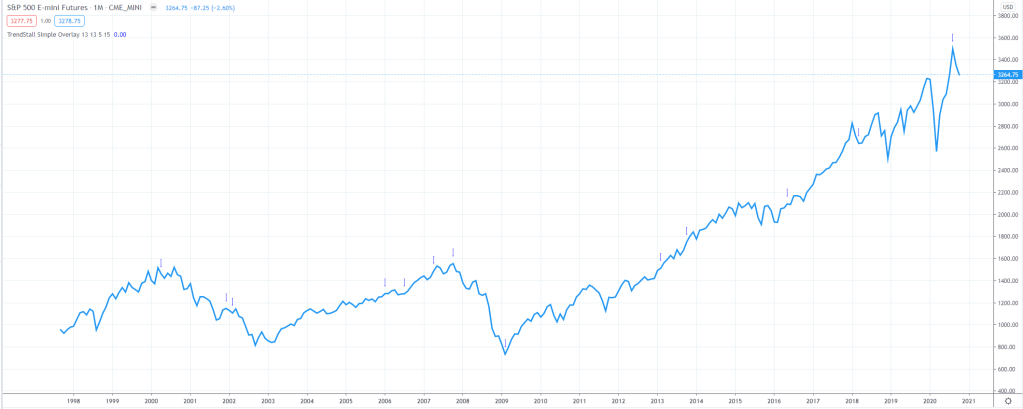
I look at charts. I try to keep emotion out, except when I can’t take it anymore and I trade on emotion. When I do that, I generally accept that I’ll be wrong. So let’s discuss the chart, briefly, and then go into the why’s. The chart of the S&P, NASDAQ, or [insert broad equity index of choice here] says buy the dips. So on an objective basis, that’s what we should be doing. But what about the post-election moves? Well, rules are rules, so let’s see how to fit this into the current narratives around what happens after the election results.

Mini S&P Futures – Monthly Chart

If we read the above, after the election the charts say the probability is markets go up. But we’ve spent 6 months hearing how if one candidate wins it goes up, if the other wins it goes down. With a trend this advanced, it’s easy to discuss reasons it could go down based on who wins. But I’ve learned too many lessons the hard way. Those lessons usually are the results of breaking so many of my own Technical Analysis tenets.

So let’s try and actually find the narrative that makes this bullish opinion work, from both sides. We can start with either side. Let’s start with the incumbent, Donald Trump. It’s been said by many that a Trump victory is what’s needed for the equity markets to continue this run. We can see where this comes from, as much of the rally is supported by banks, trading firms, wealthy individuals, and family offices with money that needs to be put to work. And while many have stashed money in bond markets over the years for safe returns, rates are too low across the board to really make this a worthwhile position to take on a risk reward basis. Even rich folks want to return more than 0% to 3% based on the risk of the assets backing the bonds, from the US government to smaller municipalities to corporations. So this money is funneled to equities and it feeds on itself…like so many rallies do.

This audience is traditionally better served by having a Republican administration driving the bus. So based on that, it’s easy to see why there is a valid argument to be made for the continuation of the current leadership. Are there counter arguments? Of course…a lot of money has been printed recently. Not the usual Republican way of doing things, but hey, whatever works. There’s not a lot of evidence that the practice of feeding corporations and the wealthy will change with a re-election, so it’s easy to see how a Trump victory leads to a continuation of this ride higher. Anything else is pulling the rug out from under.

On the other side is Joe Biden, the challenger. Many narratives say that a Democrat in the White House will lead to a large sell-off in these markets. Now history doesn’t necessarily support this, as some of the largest bull runs have come with Democrats driving the same bus. Yet it’s an easy argument to make. Taking aim at corporations and rich folks by taxing all those winnings at a higher rate, supposedly printing more money than the other side, these are the things that drive arguments for a bear market. But if you’re making money, well it’s not quite as painful to pay higher taxes. Think about it…would you rather (as the kids game goes) pay $40 out of $100 in profits, or pay $10 on $50? Well looking at percentages only, it’s easy to say the latter. But if I’m only able to make $50 vs making $100, personally I’d rather have the $60 in my pocket post taxes than $40. That’s my math.

But how does the market keep going up under Biden. Well, if we can conclude that much of what has kept these markets afloat is an expansion of the monetary base, it’s pretty fair to say that a Biden administration will pump more money into the economy. It’s how the promise to support those suffering the most financially in a pandemic gets translated into more dollars floating around. But will those who need the money most actually be buying stocks with payouts? Probably not. Rent, food, clothes and all that. But it would be naïve to expect that the only beneficiaries of a monetary policy designed overall to help those in need will be confined to that audience. And we know that interest rates won’t fly higher in this scenario, so we’re back to the place for this money being equities. Yup, bullish.

Will it play out this way? Maybe not. Maybe the second Trump administration doesn’t really keep printing money. Maybe they do find their way back to Republican roots of tighter monetary policy. Maybe the rally that has, for the most part been confined to a small selection of stocks within the indices does run out of steam with a lack of new money.

And on the Biden side? Also not guaranteed, but it’s difficult to find a scenario where a Democrat led administration doesn’t keep the printers going and interest rates low. Now granted it’s difficult to imagine getting a mortgage refinance at less than the 2.75% I just got, but we still have positive interest rates. They could always go negative on a federal level, a la Japan which means I could refinance even lower next year. Negative rates are not something I’m in favor of, didn’t work for Japan, but that doesn’t mean it can’t happen.

So where does this leave us? Well, this blog is titled The Story Behind the Picture. This is what I see as ways for the bull market to keep going. Will I be right? That I don’t know. What I do know is that I’m not getting short again until the chart tells me to. Cheaper that way. Sometimes no trade is the best trade.

Please go vote! It’s your responsibility. And if you don’t, and your candidate of choice loses, please don’t bitch about it. You only earn that right when you take care of your responsibilities.