Wanna Bet?

When I was a kid, this was the defense to someone calling Bullshit. You would brag, someone would call BS! and the response oftentimes was, ‘Oh yeah? Wanna bet?’ This was followed by some type of slim or imagined proof and then we all went back to what we were doing. My point in telling this very brief history is that betting, even in such a harmless boys sticking their chest out way, is bred into many a person’s psyche from the time they are a kid. When I lived in Hoboken NJ, one of my apartments was down the street from a known bookie joint masquerading as another (legitimate) business.

The good news was most of this was harmless. Were there always people with gambling problems? No doubt! But making it just a little bit of a chore to gamble stopped many people. Las Vegas and Atlantic City. That’s where the casinos were. On the trading floor we always had ‘pools’, the biggest being for the Super Bowl at $1,000 per box or more. Do the math; it was a bit degenerate. When I traded, many people tried to point out that I was gambling for a living. To some extent we were, but I used to explain we were the ‘House.’ We had a competitive edge and knew over time we’d come out ahead. That to me was way better than trying to figure out how many points one team would beat another by. Or worse, sitting on a casino floor pulling the lever on the slot machine. There’s a reason those machines are referred to as ‘One-armed bandits.’

Now, it’s a bit of a free for all. Or the wild, wild west as we used to call new trading markets introduced to the futures floor. The new ubiquity of gambling opportunities started with the expansion of the casino business itself. By allowing indigenous tribes of Native Americans to place casinos on their land, the dam was definitely starting to show signs of breaking. And then came DraftKings in 2012. Some sports gambling preceded them, but DraftKings was probably the first household name associated with online gambling. Even they didn’t start out that way. It was a platform for sports-based fantasy leagues set up amongst groups of friends. They usually involve a small buy in and a small prize at the end for the winning team…and sometimes an embarrassing or joke prize for last. If we think of the Native American casinos as the small holes in the dyke you use a finger to fill, this may have been the point at which we started running out of appendages.

Just like Netflix no longer resembles its original business (remember those DVD envelopes?), DraftKings might as well drop Draft from its name. It changed the ‘game’ when the Supreme Court, in 2018, allowed states to legalize and regulate sports gambling within their jurisdictions. That’s it. The dam is gone, the floodgates are open, and all hell has broken loose. One can no longer watch a sporting event without knowing who is favored to win and by how much. Add in ‘prop bets,’ the ability to bet on a micro event within the game and we’ve got, well, player and coach gambling scandals. Sure couldn’t see this one coming a mile (1.62km) away.

We worry about children and adolescents with unbridled social media. Australia has gone so far as to ban it. But there’s always a workaround, and the gambling ones are beyond simple. Speaking to people generations younger than me, they see this becoming a large societal issue. And when something becomes a ‘large societal issue,’ that society ends up bailing out the people with the issue. Does a 2pt font size warning about gambling problems really make a difference? A bit, I’m sure. Not enough, I’m also pretty positive. Tobacco comes to mind. The tobacco companies are not killing dividends and declaring bankruptcy after throwing a warning on the label. Neither does a casino. And if we believe someone under 18 (21) is too young to understand the magnitude of some responsibilities but still provide access, we are breeding a larger problem. And with that problem comes…here’s where I finally get away from moral pontificating…comes COST.

So what do we do about it? Well, currently, it seems we are expanding the ability to find more things to bet on. Definitely the wrong direction. Sometimes they are couched as ‘investment or trading vehicles,’ but in reality, it’s gambling. Prediction markets are the new golden child of products. We have old school ‘trad-fi’ (see last blog) exchanges and companies building or buying prediction markets. What are prediction markets? They allow you to place a binary ‘bet’ on an outcome. From elections to sporting events. Who will win? But these markets also allow for those micro ‘prop’ type bets. Will this person score more than ‘n’ points? Yes/No. Bet yes correctly, you win $1.00/per dollar bet. Bet incorrectly and you lose. And you can sell these bets, I mean positions. If one person is winning a political race, as the end gets closer and the polls move, so does the price of the ‘asset.’ In other words, it might cost me 30 cents to place a wager, because someone else disagrees so strongly that they will sell that opinion for $0.30 of an overall $1.00 market. They are essentially going short. Unless, originally, they bought that bet position for less, in which case they now have a profit. And as we get closer, or conditions change, I may be able to sell my $0.30 bet for $0.70. This can go on until the event ‘closes,’ i.e. election night.

The Wall Street reasoning? It behaves much like a swap or a futures contract but with no built-in ability to ‘roll’ your position. Except you can. Will the Fed lower rates by ‘this date’? That date comes and rates don’t change so you take a new position by simply making the same bet again. Well, that didn’t work, but will they then lower rates by a new date? Seems fair and harmless enough. But it isn’t. Ingrained gambling addictions don’t just vanish with some aging. They often get as bad as resources will allow. Why do I care so much about this that I was driven to write a blog about it? After all, much like trading, you are responsible for your actions and if you lose all your money that is between you, your conscience, and your family. But when temptation is too easy, it’s often difficult for people to turn away. And that leads to ever expanding safety nets.

When enough people start going broke from this addiction, the rest of society needs to start helping them out. Whether or not we approve of how they got where they are, we’ll work to find a way to feed, clothe, and shelter them. This costs me money. I’m personally a fan of the idea of tax money helping, to some extent, those in need. I’d prefer, however, to be able to throw more of our tax money elsewhere to benefit rather than rescue. There are plenty of infrastructure needs lining up for improvement or implementation. Power, transportation – that’s what I want us to be able to spend all that money on.

Look at it this way…If there was really good zero calorie and fat free ice cream, the world might be a different place. Unfortunately, that’s just not how it works. One man’s opinion.


There’s A Word For That

Finance. That’s it. That’s the word, and it’s actually pretty expansive and inclusive at the same time. When I left college, people actually used that word a lot. And it pretty much covered it. Banking, trading, much of the business world in general revolved around that single word, finance.

For those that know about the television game show Password, I think this goes from what once was probably an easy word to guess based on clues to now being a much tougher guess. Why? Well, we’ve added a bunch of words and abbreviations that people might use as clues or guess as an answer. Words like FinTech, TradFi, CeFi, and of course, DeFi. Let’s examine these terms that seek to draw hard lines between them rather than just use them as place holders while we work our way back to ‘Finance.’

First we’ll clarify the abbreviations: FinTech [Financial Technology], TradFi [Traditional Finance], CeFi [Centralized Finance], DeFi [Decentralized Finance]. I’ve listed them in what I’d consider chronological order so we’ll start with FinTech. I think this term really grew up when the ‘West Coasters’ helped make the internet a part of our daily lives. This crowd wanted to prove that they were different from their stuffy East Coast counterparts. You know, the ones wearing suits, ties, and wing tip shoes (yes, I owned a pair and still have them as a souvenir). Now mind you, as a futures trader in the pits, we really didn’t fit that mold, but we’ll leave that detail out of it. The story sounds better this way. Think about those people out there on the West Coast that were inventing all this cool shit that would make it even easier for you to constantly give companies your money…and unfortunately all of your most private information. The Steve Jobs of the world did not want to be grouped with the stodgy Solomon Brothers and Goldman Sachs crowd. They were way too hip for that.

When I think about FinTech, I actually attribute it’s start more to your credit cards and the ability to get cash from a machine. Here we may have nailed the first real example of the bifurcation or branching of this whole money and finance thing. Now you could go to companies working directly with people’s money, but in technological ‘Tech’ ways. But if you help someone transact with money and buy a pair of shoes, isn’t that something that really involves the same type of transaction as buying stock, which was clearly associated with ‘Finance?’

Next in my order comes TradFi. What’s interesting about this is that it wasn’t always part of the Finance vocabulary. It possibly took hold after DeFi, and while the logic of this order actually doesn’t necessarily make sense, that is how I remember using the terms. It’s pretty simple to understand these abbreviations. TradFi is traditional finance. It’s almost used in a derogatory manner by the crypto or digital crowd. Why? It’s just so yesterday. Paper money, stock certificates, bonds with tear off ‘coupons’ to claim your interest payment. How can anyone find that efficient. So it all went electronic; blackouts, internet outages be damned. We’ll come back to my core problem with all of these abbreviations in a bit, but let’s understand them first.

What followed next is part of the recent technological and digital (r)evolution of money that revolves around blockchains and digital currencies as well as other transferable assets, e.g. Bitcoin and Ethereum respectively. We’ll go with CeFi first. This one is interesting to me because I’m not sure I remember it being used really before people started saying DeFi. CeFi is centralized finance. Go back to all those old ways of doing things. Government control of the ‘money supply.’ International currency fluctuations. And everyone’s long-time favorite (including my own), Gold. All of the above are transacted and exchanged in a ‘Centralized’ manner. That centralization revolves around governments, banks, and exchanges. Transactions are conducted in such a way that the payment still passes through one of those government run, or at least affiliated and regulated institutions.

Last, let’s look at what can pretty much be thought of as the Wild, Wild, West. DeFi! This where the party is, or at least the place with the ability to do the most, sometimes not yet knowing if you’re really ‘permitted’ to transact that way. I’m not going to get into the crypto debate around whether or not this should really be permitted. That’s a Political Science discussion, yes, my major, around how to build your society. With all the people yelling about the future of DeFi being the new world, one could argue that the barter systems that supported societies for thousands of years were pretty much DeFi. You want something I have that has value, and I get some sort of value in return.

So why do I refer to it as the Wild, Wild, West? Because the rules that are beginning to be put into place by, yes, those same centralized government bodies and are being written more out of necessity than a desire to give up centralization. Crypto and digital assets have arrived and people are exchanging them. And many of them are now choosing to do it on a one to one, or peer to peer basis. Or, they’re doing it on decentralized exchanges, and I’m not really sure why that’s not an oxymoron at least. No matter, the governments are, as is their job, creating laws to protect people from each other and to some extent, themselves. Maybe we should discuss that last sentence in a blog around online gambling…another day.

Now to one of my pet peeves about all of these terms. ‘Fi’ always comes second. Maybe it was a way for the ‘cool kids’ to differentiate themselves; bring the focus to the technology side of things. And that’s a problem. Why? Because it allows the builders of these products to de-emphasize the Fi part and that’s a bad thing. Fi is people’s money. And I have tried to always remind my teams that after their family, people probably put money as the second most important thing. Not everybody, but on some level we all have to think about our money. Very old fashioned like gold, or just old fashioned like government-controlled currency, or new age money; digital currencies. People care more that it’s money than they do about any of the ‘Fi’ differentiators. And if you are building a product involving money you better care about your customer’s money as much as they do. I’ve seen the other side. Companies blow up.

I once spoke to someone about a job at So-Fi and asked point blank whether they considered themselves a Tech company or Finance company first. The answer was a Tech company. Tech was definitely the wrong answer. I immediately knew it wasn’t a match. Even the company tagline is ‘Get Your Money Right.’ It isn’t, hey play with all this cool technology on the phone. They’re selling money services, not tech. Tech is merely a means to an end, so why focus on that first. We’re talking about money here, the time for jingles and cool commercials is over. Is my money safe with you? Can you help me make more?

And that’s it. That’s what? That’s FINANCE. One long established, well understood word; finance. It means money. The sooner we start looking at all of this stuff as just that, the Less confusing it will actually become. And the more accepted. After all, isn’t that what all these companies say they really want? I’m waiting, and I’m ready. Hopefully, if no one else has gained anything from this installment, I’ve at least made all the Finance majors out there happy.

Step Away From The TV

…Or the computer screen, or the cell phone. Unless it’s to put on some meaningless background noise. That’s what we did in the prop trading shop. We rarely had CNBC or Bloomberg TV on. Generally, we tuned into sports, Netflix, that type of thing. Something you could ignore. Business channels? Maybe if there were interesting things going on. This would probably have been one of those times.

Traders have often latched onto the saying attributed to Confucius, ‘May you live in interesting times.’ Blessing and a curse. To a market maker like I was, volatility was something we looked forward to. But as you’ve probably gathered from previous blogs, we were a different breed. Like people that love the biggest roller coaster you can find (me), vs sane people. And it’s not just the old pit traders from the floor. The early days of screen trading had tons of opportunity for that style of trading. Now? It’s awfully tough for a person to compete with the speed of machines. It’s really why I preach to you, my readers, to not gauge your success on a daily basis. Look at trading, or investing is an even better term, as a long-term game proposition. That’s something that has yet to go out of style.

Meanwhile, back to the television. The thing about our prop trading office was that we didn’t trade off of the host’s discussions that tried to explain sudden news or even, for the most part, off of the news headline itself. We would switch to CNBC, however, when something new did come out (flashing on our screen), so you would at least have a basic understanding of why your trades, win or lose, went the way they did. You’d hear someone say something and stop to listen briefly. It’s a bit of a talent to filter noise while still being able to grab the occasional important tidbit. Or maybe it was ADHD. But either way, the stops were in. Now move on to the next trade.

Other than the very, very small community of insane traders, the thing that virtually everyone that interacts with markets does not want is extreme volatility. Pick a direction. Progress, up or down, over time. I’ve been asking friends/colleagues in the finance world how their necks are. It’s really a type of mental whiplash. The constant knee jerk back and forth will destroy any trading strategy. In crypto, people look at how many positions, or how much nominal capital losses were stopped out, or ‘liquidated.’ I don’t consider watching others lose money a sport. I will say that crypto has not been shielded from what’s going on in traditional markets right now either.

But it’s exactly those traditional markets moves that are leading to stories you’re reading. I’m not passing judgement on tariffs or any other current market moving news. I am passing judgement on surprises. They’re bad. And when they rock the bond market, they can be really bad. Why. (Yes, I know there should usually be a ? to end that sentence; this time it’s a statement)

Because bonds are different. Interest rates are different. I’ve written a blog on the slow movement of interest rates. I followed up by admitting that, in that instance, I was wrong. The Fed moved one way then shortly later moved the other. When thinking about interest rates, it’s easy to understand why these are generally long term ‘trending’ markets. Because long term decisions are made based on the expectations of interest rates. Should I buy a house now? Will lower mortgage rates a year from now position me to buy a larger one? Or in my first choice of neighborhood? Or, will I be upset if I don’t pay over asking for this house now because next year interest rates may not allow me to buy it at all. Everyday decisions for everyday people.

Businesses, from small to large corporations, also can end up successful or not based on interest rates. To put it in business or economic terms, what is my cost of money. If I borrow to buy some new equipment for my neighborhood store, or build a new factory for my large industrial corporation, how much does it cost me each month? Business decisions for business people. Same thoughts, just different scale.

So that’s it. That’s why what’s going on around us is, to me, more f’d messed up than usual. Because it’s surprise after surprise after surprise. Usually when these types of things happen, it’s one surprise. Granted, one BIG surprise, but then it’s done. Mortgage meltdowns. The Bernie Madoff events that cause instant selling (or buying) before cooler heads prevail. So what’s the answer?

Where we started. Don’t make trading decisions based on the news of the minute. How do you avoid it? Watch, read or listen as you would to other news stories. Crazy weather occurrences. Royal coronations. Your town’s high school won the state championships. P-Diddy; well, maybe not that one. But you get the idea. This is important news, no denying it. It can and will impact all of us. No denying that either. But we can’t let it impact our outlook on a momentary basis, because in the next moment, whatever ‘it’ is could be going the other way.

This is one of the times where you have two choices; well, three if you count losing all your money as one of them. The other two choices are, Sit on Your Hands or Shut Out the Noise. Sitting on your hands means you’ve made decisions before based on information gleaned over time, technical charts or fundamentals, so expect them to still play out, over time. Unfortunately, that time may be longer and a much bumpier ride than you initially expected.

Second, shut out the noise. Like when we’ve spoken about Discipline being SIN’s #1 Rule, this one is much easier said than done. You can start by turning off financial television, radio, podcasts…or at least just use them as background noise, as I mentioned earlier. Keep following the people you followed before we hit this volatility, and give them the same respect they’ve earned over time. The ones who just shout out how ‘right’ they were? Yeah, drop ‘em like that bad habit on New Year’s. But stick to this resolution. Or look at it as entertainment. Like professional wrestling. You know they’re full of shit, but it doesn’t mean it can’t be fun to watch.

So that’s how we handle the Surprise of the Day atmosphere we’re living in. Take a step back like always, plan your approach, and stick to your plan. I’ll check back here in the near future and see how everyone’s holding up.

Perspective, please!

I have been finding it extremely difficult to come up with topics that will not lead to people (on one side or the other or both) flaming me for taking a side politically in a blog that is intended to promote thought without inserting a political opinion. But then, as so often happens over the last 10 years, crypto comes flying in with something to write about. The gift that keeps on giving. Here goes:

One on side we have; Crypto is over, It’s crash and burn time, We warned you it was just like tulips, yada, yada, yada…again.

On the other side we have the usual crypto refrain; ‘When in doubt, Zoom Out.’ The phrase is a way of saying a longer-term view will change your opinion what you’re seeing in the short term. This idea comes from, yes folks, charts!

Obviously, anyone who has even casually paid attention to my blog knows I’m not in the first camp. To some extent, I’m actually not in the second one either (Surprise!), though overall those are definitely my peeps.

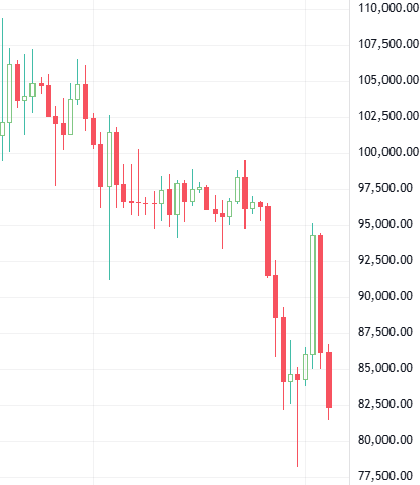
So, let’s explore both sides of the current arguments. First, crypto is dead. As I have been doing since Bitcoin dropped from around $1200 in 2013 to under $200 in 2015, I’m going to declare crypto is not dead. I’m not even sure it’s sick. It’s actually starting to try and grow up. How can I say that after this current sell-off from almost $110,000 to under $80,000 in mere weeks?

I still look at crypto as evolution of a blockchain, as I have when I was first introduced to bitcoin in 2012. In that light, it’s not going away. Meme(shit) coins? They can go away. The opinion out of Washington this week that shitcoins are collectibles actually makes some sense to me. Kind of like Pokémon. I might have to start actually referring to them as meme coins now. The hard part is determining when a meme coin essentially gains utilitarian value of some sort and is no longer a shit, I mean meme coin. But this is a meaningful step forward, so I’ll take it.

Now this sell-off? C’mon folks, no market goes straight up without ever looking back, rocket emoji’s or no rocket emoji’s. 🚀 Have you not been paying attention to this space for the last 50 something blogs I’ve written? Market pullbacks, while at times violent, are not only healthy but actually necessary. That’s how you avoid the tulip thing. By getting rid of the tag-along lemmings and giving new buyers a chance to play.

Look at anything that you consider a ‘bullish’ chart. There were stumbles, even some falls along the way. Yet, stuff still has managed to set all time-highs recently. No, not crypto silly, the S&P, the Dow, etc.…you know the stuff my mom refers to as ‘the market.’ The thing is we get conditioned to things going up, it’s kind of the idea behind the stock market, pensions, 401k’s etc. When things do go down, it’s often much faster than they go up; and that’s not just crypto. While we can talk about weak holders, stop orders, and the like, I generally just chalk it up to gravity at work.

Ok, so now we’ve covered the ‘Crypto is Dead’ piece to a decent extent to find it acts like almost any market. Don’t believe that the drops are as violent in other markets as they are in crypto? Have a look at commodity Futures sometime. Pick a future, any future. Metals? Look at Silver. Energy? Look at Natural Gas. Not convinced? The price of Frozen Concentrated Orange Juice, the Futures of Trading Places fame, declined by 60% over the last 2 months! We’ve been drinking OJ for a long time. The ups and downs of the Futures market may ebb and flow, and the amount we drink may do the same, but society doesn’t as a whole doesn’t stop drinking orange juice altogether when prices go up. Some people do, and this in turn gives the market some new breathing room.

So now back to crypto crowd and their mantra of When in Doubt, Zoom Out. This recent sell off is a great time to actually see what this looks like!

Well, that’s pretty ugly. That’s a daily Bitcoin chart for the last couple of months. It may even be bordering on f’ugly (you can figure out what that means…). If we do the math, Bitcoin dropped 28.5% in a little over 5 weeks. Orange Juice does that without breaking a sweat as we just learned. Is this the bottom for Bitcoin? If it is, my timing is more luck than anything else. But what it isn’t is the end of crypto. Let’s do that Zoom Out thing, shall we?

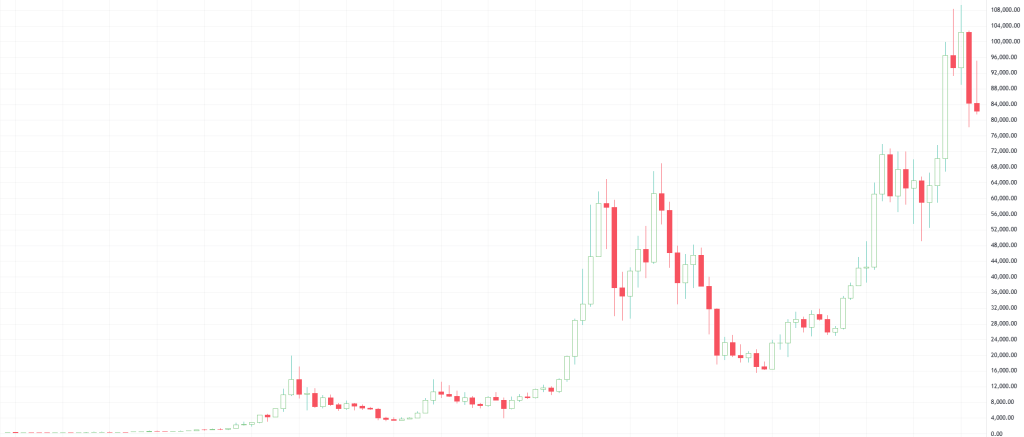
Almost 10 years of Bitcoin history (monthly chart candles). We can definitely look at it and say ‘We’ve seen this movie before.’ One thing that jumps out, to a chart nerd like me anyway, is that the most recent big green up candle in November had a bigger range up than the just finished February down candle. Maybe gravity and physics are not the most powerful forces here. Nope, just lemmings and human nature and money. Piling into a trade then gate crashing the exits to get out. Notice I used the word trade in that sentence, not investment. And that’s why I’m not convinced this is the end, even if there is not, I’m sure, a shortage of people licking their wounds from this last drop.

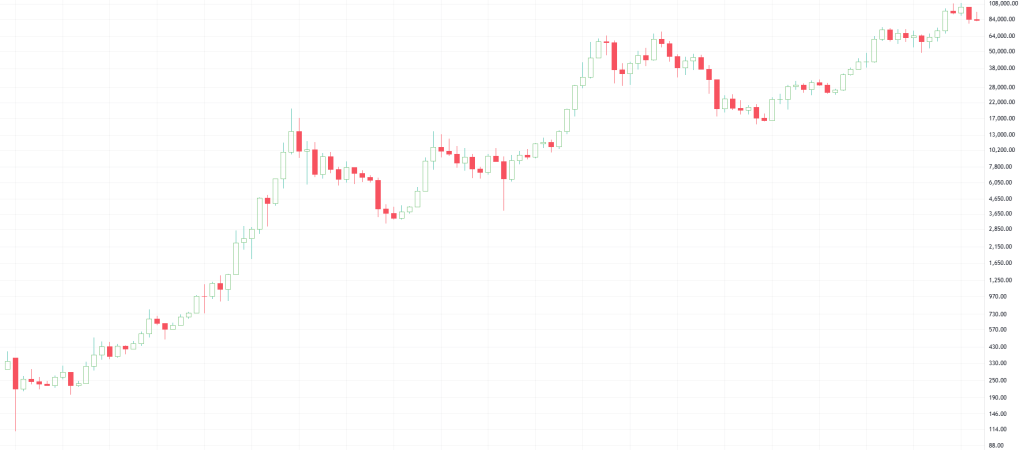
Here we are looking at the same monthly Bitcoin chart built on a logarithmic ‘log’ scale vs the previous linear scale, which gives an even different and to many, a better perspective. Given the history, this move actually looks rather tame. We could add lots of Technical Analysis derivative indicators to the chart to help expound on the why’s and when’s of the moves above, but there’s really not much need. It goes up. Not rocket ship up, but still up.

I will also point out that there are many that will find a buying opportunity somewhere. It may be lower, it may be higher, but those opportunities will be plentiful, though they are rarely easy. This is what sustains markets, has helped sustain crypto for more than the time I’ve been involved even, and will continue to keep the crypto markets, as well as others like Frozen Concentrated OJ Futures, healthy.

In case you’re new around here, let me reiterate my ‘opinion.’ Same as it was when I was first introduced to Bitcoin in 2012. I’m bullish. Back then, it wasn’t due to charts – didn’t have good data, but rather fundamentals. And that also has not changed. For while I do focus on charts and technical analysis, there is IMHO, sound fundamental reasoning behind cryptocurrencies. No, it does not center around illicit activities like Silk Road (one of those down moves on the chart) if that’s what you were thinking. Actually, different fundamentals, and different illicit activities that include Al Capone as an example. As I look back, I’m astonished that I haven’t covered that part yet, though I did touch on it briefly here.

I think I’ll just let you ponder the connection until the next time…

Only 10?

Only 10?

With the recent melt-up of bitcoin and much of the crypto/digital asset universe, I decided I’d write something. Wasn’t sure I would do this again, mostly because it’s been so long, but with the rally I decided to write a kind of Part II to my previous blog https://billsindel.com/2021/05/13/trading-is-hard/. In that edition I posted my SIN’s 10 Rules of Trading. I realized I’ve never really addressed them, and while they don’t necessarily need much explanation, I thought I’d go through them anyway so you can understand why I picked these 10. Most traders could make a list far larger than that, all learned from mistakes.

While many people making these lists start at #10 and count down, I’m going to start with the most important one, in case you decide to stop reading before the end. And so, with no further delay, here’s SIN’s 10 Rule of Trading:

Rule #1: Discipline [ disuh-plin ] nounbehavior in accord with rules of conduct; behavior and order maintained by training and control.
That definition was one of nine listed and was actually used in a sentence related to the military as an example. It makes sense to me since it’s not generally an instinctive trait; it’s something you need to focus on until the ‘behavior’ is second nature. If you’ve ever spoken with a successful trader, you will have heard them use this word. No matter how you go about your decision making, be disciplined. A disciplined trader with a mediocre strategy will be far more successful than an undisciplined trader with a great strategy. Don’t change your outlook because you want the asset to go up (or down). Or because you’re wrong. Just repeat the same habits that lead to profitable trades. Don’t talk yourself into or out of something when you know it’s not what has previously been effective. This one word, discipline, sounds so simple, yet when you have skin in the game and the success or failure of the trade or position will impact your life, it can be extremely hard to maintain your discipline.

Rule #2: Don’t Add to Losers
The point of this is not necessarily to say if you bought it at 10 don’t buy more at 9. What it really means is that if you have a position that goes against you enough that you know you should get out, don’t add to it just in case there’s a 50% move back and you can get out even. Could it happen? Of course! Does it happen? Of course, again. Will it work when you try it? Probably not. Why? Because you’re not adding because of support or resistance, you’re adding out of hope and prayer. Hope is most definitely one of those four-letter words you need to avoid when it comes to trading. Oddly, I think so is love; I love this position oftentimes doesn’t end well. We’ll get to this later in Rule #9.

Rule #3: Make A Plan and Stick To It
If you buy something and say I’m going to sell at ‘A’ profit or ‘B’ loss, then do it! If, as part of your plan, you buy half figuring it could go down a bit and you can buy more but at least you’re in, then do that. Don’t get this one all mixed up with Rule #2. A negative P&L isn’t necessarily the reason to get out, it could mean the asset has traded all the way down to a support level and you decided in advance that you would buy more there. That’s a plan. So do it. And if you say I’m going to sell ½ when it goes up to a certain point, do that too. Greed kicks in when your trade is going your way; same way Fear sets in when it’s going against you. Just stick to the friggin’ plan!

Rule #4: The Market Is Always Right – You’re Not That Smart
Too many times someone will say, ‘why is this going down? The news is great! The market is wrong, they’re all going to lose money. I’ll be right in the end. That’ll show them.’ Yeah, OK Einstein. Seriously? Maybe it’s a ‘Buy the Rumor, Sell the News’ situation. Everyone expected the news that came out and bought before it was official. When it came out, the buyers had already done their thing and now were taking some profits. Or maybe there was a small nuance in the news that you just missed. Or, or, or…too many reasons for you not to be the smartest one in the trading room. Sorry if I hurt your feelings. On to the next trade, er Rule.

Rule #5: That Feeling In Your Gut Is Indigestion
I’m pretty sure I’ve covered this one previously in a less definitive way. People very often trade on ‘their gut.’ And I’ll be the first to say that for a very small number of traders it works. Now I believe this is because they get the same feeling each time a specific setup presents itself and for some reason, they feel it physically. Really, it’s the result of years of seeing the same thing over and over, doing the same thing in reaction over and over, and making money over and over. For the rest of us, it probably means we’re wrong and the feeling in our gut is nerves telling us we’re fooling ourselves…or it could simply be the fish you ate last night.

Rule #6: Don’t Chase A Trade – There Will Be Another Opportunity
Sometimes you’ll have a plan to enter a trade and you miss it. Oh well. Shit happens. Move on. You will always miss trades. That’s actually the good news. It means there are enough opportunities out there that you don’t have to wait long for the next one. But wait for it. If you ‘chase’ a trade you’re changing your initially planned risk/reward setup for the trade. Now you’re changing the plan you thought would work. Refer back now to Rule 3. It’s about the plan. Stick to it. If you missed this trade, make a plan for the next one. Better use of time and energy.

Rule #7: Let the Market Dictate Your Exits – Not Money
This one may be a bit more esoteric, but it’s a rule nonetheless. What I mean by this is, when you put on a trade don’t say I’m putting this on to make my rent for the month. Or just enough for dinner. Set your exit the same according to your rules. Saying ‘I want to make $100’ doesn’t justify your entry or exit spot, unless it’s coincidental. Get in the trade. Enter your stop and target (if you have one) for the same reasons you always do. That’s how you make rent money.

Rule #8: Learn From Mistakes or Repeat Them
Kind of a general life rule, no? I’ve always told new traders to keep a detailed trade log. Write down why you got in and out of every trade. Then review it at the end of each week. What sucks is writing the same stupid mistake down multiple times, because as you’re reading it again and again you feel like a total idiot. The good news is I never told anyone to read it out loud to friends or family, even if may have thought about it…lol. Seriously though, this practice reinforces good habits and helps drive home the bad ones that continuously lose you hard earned profits and should therefore be avoided forever more.

Rule #9: Save Emotions For Your Family
I’ve always believed that getting out of trades, winner or loser, is harder than getting in. Why? Because every tick of the market means you have more or less money. That can get emotional. When I left the trading pits, I started writing computer trading models so my exits would be calculated automatically and my emotional state at any moment would not interfere with the successful execution of my trade exit. As I’ve gotten older, I’m finding it easier to trade unemotionally, but I still won’t trade without a Stop order in place. I just don’t trust my own emotions during decision making times. To me, this is all numbers. Price, Volume, derivative indicators, e.g. Moving Average, are all just numbers. It’s binary. Up/down. Profit/Loss. Where is there room for love (or hate) or any other feelings in there? There isn’t. But there’s plenty of room for love and other emotions, pride, admiration, etc. when you’re with your family. Just please keep both your feelings and your family out of the trading room.

Rule # 10: Remember Rule #1
‘Nuff said.

Will following these rules guarantee success? Of course not. But it sure will increase your odds of success, and as a Technical Analyst looking at charts, I’m really just trying to maximize the odds of success in my favor. So, start with these rules. Add or substitute more of your own as you go. Just don’t forget Rule Number 1…or Number 10.

It’s Been A Year (aren’t they all?)

A reader and ex-colleague suggested it’s been a while and I needed to write something. It has been a while, and while thinking about a topic I decided to write about a few topics as my own Year in Review. Don’t worry, it’s not going to be 3x the usual length.

So let’s think about 2023, and I’m going to leave out politics unrelated to financial markets and crytpo because, well, this isn’t a political blog. It’s one about how stuff in the world impacts markets and there’s enough other shit to write about. Like recession, inflation, and back again. Like a terrible job market that is still showing an enormous amount of historic strength. Like the insane electric vehicle growth that didn’t happen. Or even the way suddenly high mortgage rates were going to crash the housing market yet Zillow still tells me my house is worth more on a monthly basis. OK, AI is in there somewhere. And of course, as someone who has been involved as deeply and as long in digital assets a I have, we will discuss Gary Gensler. You didn’t think I’d leave him out, did you?

The big picture; what is going on with our economy. Honestly, I’ve got no friggin’ idea. I can throw out some thoughts and ideas, but like all the ‘pros’ and those making the big decisions (do Fed governors count as pro’s??) I’ve probably been wrong more than right on these predictions. We’ve gone from the easiest money on record, mortgages under 3%, to a peak of 8% in under 2 years. I’m one of those tied to my house forever as I’m paying 2.875%. Thankfully we like living here.

Those rates went along with the rampant and rapid inflation we all felt. Now, it’s not like some of the stories we hear about in South America of 100%+ annual inflation rates, but when Hebrew National hot dog packs go from the traditional 7 hot dogs to 6 (never understood the 7 thing) and a Ben & Jerry’s ‘pint’ is now 15.2 ounces I’m feeling it. So, what’s next for the economy? We’ve supposedly put the crazy rates to rest for now as the Fed is stopping raising rates and all the ‘pros’ (remember them?) are calling for multiple rate cuts in 2024. Soft landing? Recession? Back to that idea of Stagflation? Yeah, I mentioned that one, but the economy is too strong for that one…for now. Definitely no predictions from me, I could pick all three and probably still end up wrong.

The job market has been kind of all over the map like interest rates. I was, unfortunately, part of a 20% layoff…er, I mean ‘Reduction in Force (RIF)’ this year. It happened as layoffs were being announced weekly, with over 250,00 tech workers (Finance and Crypto included) lost jobs in 2023 alone. When you’re part of the number, it definitely feels like a lot of people.

And yet, the latest reports and the charts say that this was a rapid but relatively brief event. I can personally say that I see the change back from the doom and gloom of six months ago as I look for the next stage of my professional journey. Companies are realizing that they need help and they are really going to survive so it’s time to build for the future. This is In crypto, it’s in traditional finance, ‘trad-fi,’ so I can only figure it’s happening elsewhere as well. Thankfully it allows me to be more selective about what that next stop looks like.

I’m also a car guy, so I’ll lightly touch on electric vehicles. The car makers have planned and built for explosive demand. It was supposed to be the big moment, or at least the beginning of a big moment, for the car industry. Then consumers spoke. We want range; not just claims of range but real range. Over the river and through the woods holiday travel type range. And we want to recharge in the time it takes to stand on line for fast food at the rest stop. A close friend had a Cadillac Lyriq briefly as a loner car. We went out in Hoboken for a couple of hours. After we were done, the car showed it had charged enough to drive for around 60 more miles than when we started. This was not fast food so we’re definitely not there yet.

Other issues? Well, insurance companies are starting to realize that repairing electric cars is not like fixing your father’s Oldsmobile. These things get totaled constantly. Tesla batteries help actually stiffen the car but they are a lot more expensive to replace than realigning an old school car frame, and insurance rates are starting to reflect that. It’s not a recipe for consumer adoption with all that inflation going on…

Housing? I don’t think I need to point out what’s happening. Either you can’t afford to buy a house because of the high rates or you can’t afford to sell one because of the high rates. It’s kind of a Catch-22. So new stuff goes up; around here it’s townhouses. Sure makes my house with a yard more valuable to a lot of people. But as I said, it’s not for sale…well…everything has a price, hence my monthly ‘theoretical’ increases in value.

This one is interesting because should rates go down, my house becomes more affordable to more people. That’s what led to the last round of bidding wars. As those of you who know me, or have read a bunch of these blogs, I’m not going to say real estate can’t go down. Especially when everyone else seems to have thrown in the towel on that one and just accepts the steady increase. But short of a real ugly recession, how does this happen? Hmmm…I do hope that wasn’t prescient…

AI really stole our attention this year. Depending on the font, you may think that’s short for Allan. Actually we’re talking about artificial intelligence. I vividly remember 2-3 years ago being told college is dead, kids just need learn to code. Fast forward to 2023 and every engineer I talk to is convinced that computers will write code faster and better than humans. Personally, with some debugging (Product Managers do a lot of that) I’ve gotten ChatGPT to help me write some awesome code for my personal use. Way easier than learning multiple computer languages.

There’s plenty to be scared of with AI, but also plenty to be excited about. Healthcare will benefit in ways we can only dream of. Financially supporting all these people that will live longer and (supposedly) need to work less is definitely something worth discussing, but I’ll reserve an entire blog for that…next topic picked! Personally, I’d like to not worry about cancer. Or to have better solutions for my spinal issues. Even better weather reporting and things we don’t necessarily ponder daily will be greatly improved. Aside from the weather forecasters on TV taking less crap for constantly being wrong, predicting things like hurricanes, blizzards and everything in between more reliably will save lives on a regular basis. I could go on, but like I said, another blog.

Ok, crypto…with a touch of Gensler. A year ago, crypto was dead. Again. Crypto winter. No one has a use for it. I call bullshit. No doubt a lot of small crypto start-ups ran out of money, or thought they might and had layoffs. But the folks that are going to make digital assets a part of not only my everyday life but yours as well, were building. And building. And building. Thankfully we had AI taking all the attention so it could be done properly, which often means quietly.

Traditional finance players and the crypto kids alike are all working on ‘tokenization’ of assets. What does this mean? Like much of the digital space it means better record keeping, more reliable proof of ownership, and eventually more control over things you own. I try to preach that this is all evolutionary not revolutionary, so when you turn around in 5 years and everything is accessible to you and no one else simply through your phone, you can remember this paragraph. We used to wonder what we would do with an ‘Internet,’ now we struggle to understand how we’d function without one.

Unfortunately though, like most roads these days, this one has potholes. One of those potholes even has a name; Gary Gensler. It is amazing in a society built on not letting one person have too much power, we have this person standing in the way of what so many are looking for, defined regulation. It’s interesting to me because my Political Science major had me on the side that a government’s job is largely to protect people from themselves. This is what the SEC is there for. To tell us how to not be dumb enough with our money to lose it all. So, we’re all asking for some rules to help that happen. The SEC needs to realize that digital assets are not going away.

The people are speaking and have spoken. In fact, the US is falling behind. The EU and Great Britain are working with the industry to figure out how to make crypto as safe as other assets. The SEC under Gensler is acting like a petulant child that owns the only ball on the block and doesn’t want anyone else to play with it because no one is picking him first for their team. We’re all in this together, Gary. Stop saying ‘La, La, La I can’t hear you’, and listen. Regulation by random enforcement is not the long-term answer. There’s a lot of smart people working on this stuff, I’m sure there are many other solutions that can achieve your supposed goals, it’s time to find one.

So that’s it. That’s my summary. A bit longer than usual, but hopefully worth the read. The only prediction I will make is that next year will hold just as many surprises and we’ll all be wrong with our predictions. Or most of us will be. I’m confident I would be, so I’ll pass for now. Just gonna wish everyone the best going into the new year. I appreciate everyone that takes the time to read this, and hope I can keep you interested in 2024…and maybe even post a bit more often.

Dollars and Sense

Much of the point of this blog revolves around money. It revolves around success. It revolves around different news items that will impact business, markets and in turn, life. I will often, during a conversation, make a point using a trading metaphor. It’s all risk/reward according to Bill, remember?

The United States is an economy based on business. In fact, I think that the US economy is a business. Our government is here to help us have an orderly society, but they partially base that on an orderly economic system, i.e. the Full Faith and Credit that backs the US Dollar. And in return, we pay the government. I’m not here to say that it’s a bad thing, or start a discussion on the fairness (or lack thereof) in our tax system or solutions to the many problems within. I’m here to point out that collecting money is one of the things our government does, and therefore in my mind it’s a business.

The idea of a business is to make money. In theory, the US is a non-profit but it does need income. And it’s got competition for that income. Other countries are also in business. They all have spending that needs to be supported. Yes, they also all go into debt (we certainly do, but that’s for another blog entry), but other business take out loans as well. Hopefully you’re beginning to see my point. The neighborhood bodega and the US Treasury are very similar. Perhaps a Credit Union would be a closer comparison, but let’s throw some love at the local bodega; it’s a tough business, as is collecting taxes.

All of this brings me to my Question o’the Day: Why is Gary Gensler trying to convince an entire industry to move out of the US? I have been deeply immersed in the crypto industry for over 5 years. Both of the places I’ve been, Kraken and Anchorage Digital believe in doing things in a manner that should and could be fully in line with traditional financial industry (TradFi) regulations. AML/KYC is done, records are retained for years, yada yada yada. Point is, these entities are following at least most of the rules. Kraken actually paid a fine and stopped a staking program in response to enforcement action. Same thing JP Morgan would do for a similar faux pas.

Yet, here we are. Binance being hunted (I’m not sure some of it isn’t deserved), Coinbase stock tanking in response to SEC action taken earlier this week. Anchorage has an OCC Consent Order hanging over its head, with every effort being made to satisfy all the conditions. Kraken and Anchorage seem to be in the position to at least keep doing business, but is that just for now? Wasn’t all that long ago that a few banks had some troubles. I’ll write a blog about the Fed’s role in those next perhaps, but it wasn’t lost on a lot of people that the problems seemed to start at banks that were particularly crypto friendly. Coincidence or Conspiracy, you pick your side. Either way, it’s not good for business.

All of these firms, save Binance, have continually tried hard to engage with regulators and get true guidance and regulation around the industry. The only one Gary Gensler seemed to listen to was Sam Bankman-Fried. Remember SBF? I’d hate to think that all this noise, and torching of an industry, would be to save face. Everyone in the industry has been wrong. Traders, Portfolio Managers, Analysts; they all learn from their mistakes and move on. Letting your ego get in the way of what’s best for an industry and truly for investors? Again, not good for business.

As I’ve often commented, crypto is a genie that isn’t going back in the bottle. As an ex-trader, if there’s the opportunity to buy something low and sell it high, people want in. And if there’s liquidity as has built in crypto, the opportunity is more and more attractive. The finance world is waaay too invested (pun intended) for this to be shut down. Particularly by the only person that seems to believe he can do it. Other US financial regulators as well as people in Congress feel dialogue will lead to the best solution…and then that solution can be taxed! And that, my friends, would be good for business.

Ask the European community. They understand that creating rules for firms to follow, even if barely, will result in more trading, more fees, more taxes, more income for a government. This is good business. This is intelligent use of resources. It takes a lot less to figure out how to fit these products into rules that actually exist or can be written and thoughtful than it does to sit and try and burn the whole thing down. We’re looking at a LOT of lawsuits in this country. For what? Postponing the inevitable I truly believe.

Yes, regulation is good for business. The EU approved MiCA in May and plans to have it implemented by this time next year. The UK has stated that they will have regulatory framework for crypto assets in place in 2024 as well. The US? Looking for ways to shut down every crypto business they can find, even if it’s a couple of degrees of separation. So it’s clear the path to success for the financial crypto firms is to move out of the US. If this was the end of it, maybe livable…but it isn’t the end of it.

I’ve lectured on how crypto is not so mystical as it is simply an improvement on the idea of a ledger, used for thousands of years in different forms. So if we buy into the fact that record keeping is what this is all about, and with it transparency, equality, financial and personal empowerment and freedom, then really moving crypto offshore will move a great deal of innovation with it. The companies that will rely on some part of a crypto will spread across virtually every industry. I remember my dad using early IBM PC’s for accounting; Lotus 1-2-3. Now my computer is in my pocket, connected to yours and everyone else’s. I’m glad we didn’t send Lotus and in turn Microsoft with a little product called Excel to another country.

So where do we stand? Waiting for the inevitable. One person to realize they can’t always get what they want, but that the country should get what we need (shout out to The Stones). Regulators and regulations that really do have my best interest at the center. It would certainly be a good start.

Oops…I Did It Again – FTX Edition

There are times I tell myself to post something, and I have a topical idea, but they just don’t seem inspiring. Then this week happens. If I want to have a timely topic, it’s not a reach to figure out what it is. Let’s talk FTX, crypto, smart people, hubristic (it’s a word I looked it up) people, and the rest of us.

As someone with decades of experience, having watched crashes, scams, crashes caused by scams, I didn’t see this one coming. I figured we needed an ‘event’ in crypto, but I didn’t think this is where it would happen. I was an SBF fanboy. I really thought Sam was smart enough not to be dumb. But…shit happens. Again and again and again. My most vivid memory of super smart people blowing up in spite of their intelligence is probably the Long Term Capital Management blow up. I’ve mentioned this one before, smart people being dumb.

So how does stuff like this keep happening? Previous fails being brought up in comparison to the FTX blowup; Enron, Madoff, even Lehman Brothers. Recently I saw a mention of MF Global, which kind of seemed like a good analogy. But when you dig in, is this exactly the same as any of those? No. But that isn’t really the point. The point is that we seem to semi-regularly have these ‘events’ and every time there are countless articles, also by smart people, saying I told you so. Then why do we keep listening to the wrong smart people? Let’s try and unpack at least some of the personal and group thinking that leads us astray over and over.

There’s greed. That one is pretty simple. We want to make money…today. Enron and FTX both encouraged their employees to buy stock in the company. Kind of doubling down on your employer. Enron’s CEO, Ken Lay, campaigned hard for those employees to do this weeks before the collapse of the company. He knew. FTX, from what we’re learning, was most likely supporting the losing trading operation at Alameda Research, an affiliated firm that actually was the reason for FTX to exist in the first place. FTX was created in order to provide a place for Alameda to better access crypto markets as a liquidity provider.

If the overlapping parts of all the stories and rumors are true, the small circle of people running both firms knew that FTX was funneling money into a money hole. And yet this management team told the employees to buy more. Just another source of outside money to feed the beast. Why? Cutting losses is hard. Big reason why Trading is Hard. It hurts. It hurts financially and it hurts emotionally. You need to admit you were wrong. But the hubris of the success that you initially had leads you to believe you’ll be right in the end. Everyone else is wrong.

This same hubris also leads to CEO’s forgetting something that needs to always be remembered; the more successful your company and the more it grows, the more lives you now have in your hands. It’s a real responsibility. Those people are following you and your vision. When you say we’re changing the world, they believe it. When you say buy more stock, they do. And when the plan you’ve masterminded to keep yourself from cutting your losses and losing your sudden found wealth blows up, those people are the ones whose lives are impacted the most. Some will be wounded, some will be broke. All will become just that much more cynical.

So if we’ve seen this repeat itself over and over why do we keep jumping in the pool? Our own greed. Our own FOMO (Fear of Missing Out). If my neighbor is making money I want to make money too. And even in crypto, much of what’s out there is headed for the same fate as those FTT tokens issued on FTX…worthless. When Changpeng “CZ” Zhao, CEO of Binance said he’d sell $2 billion worth of FTT tokens, he was well aware he couldn’t. It’s what’s known as a thin market. The beginning of the end.

A thin market is when there are not a lot of people looking to buy or sell something on a large volume basis. Think of it this way; if last week and the week before houses on your block sold for $500k, you would reasonably expect to be able to sell yours for near the same price, particularly on one of those blocks where all the houses are exactly the same. In a normal situation, where there’s a house or maybe 2 for sale on the block, this is probably a reasonable expectation. But (!), if all of a sudden 19 of the 20 houses on the block went up for sale the same day you probably aren’t getting that $500k. Someone on the block is going to sell their house to the first buyer they can find. And then the rush begins. The rush to be the next seller. Now the prices on the block crater.

Other markets work the same way. There are a lot of people that own Bitcoin and see some value in it. The only value in the FTT token was FTX. And if someone with $2billion worth wants to sell he must know something. At least that would probably be the perception. And now the rush to the exits begins and anything connected to the FTT token, and in turn FTX collapses along with it. I’ve referenced the words of my wise friend before; Lather, rinse, repeat.

So that’s kind of how we got here in a very very general way. The point was not to delve deeply into the collapse of FTX itself, but more why similar events will happen in the future. It’s a combination of factors; individual greed, group greed combined with FOMO and jealousy, and less not acknowledging the past but more always convincing ourselves that this time it’s different. Sure it is. Just like the most recent Halloween movie (#13) was different than the first. But the common theme remained. Everyone has, as I’m so fond of saying, seen the movie before. We still spent over $43 million to see it opening weekend. ‘Nuff said.